
How to store a body pillow between uses
Store a body pillow for weeks or months in 5 steps: follow the maker, clean and dry it, pick a bag and spot, check compression rules, and air it out.
By Cove editorial team · Updated October 27, 2026 · 6 min read · Editorial standards

Key takeaways
- Always check the manufacturer's care label before choosing a storage method, because fill type determines what is and is not safe.
- The pillow and cover must both be completely dry before you seal them away, since any trapped moisture can lead to odor or mildew.
- A breathable fabric bag in a cool, dry indoor space is the most broadly suitable storage option for most body pillows.
- Vacuum compression is only appropriate if your manufacturer explicitly permits it, and is generally not recommended for shredded memory foam.
- Before reusing a stored pillow, inspect it, air it out as directed, and check that the fill has recovered fully.
Wash the cover and fill following the manufacturer's instructions, make sure both are completely dry, then place the pillow in a breathable bag and keep it somewhere cool, dry, and away from direct light. Check the label before compressing or folding, and air the pillow out before using it again.
Start with the manufacturer's storage instructions
Before you do anything else, find the care label on your pillow and any documentation that came with it. Manufacturers specify care instructions because fill materials behave differently: solid memory foam should not be submerged in water, shredded memory foam requires careful handling to avoid damaging the individual pieces, and other fills have their own requirements 1. Storage guidance follows the same logic. If the documentation says to avoid compression, that instruction exists because the fill will not recover properly if it is held under pressure for an extended period.
For the Cove Classic and Cove Mini, the zip-off covers are machine washable on cold and the shredded gel memory foam fill is adjustable through an inner zip. Check the label and any printed care card for storage specifics before choosing your bag or container.
If you have lost the original documentation, the manufacturer's website or customer support is the right place to check — not general internet advice, which may describe procedures for a different fill type entirely. Different constructions really do require different approaches, and what is safe for one pillow can cause lasting damage to another.
Make sure the pillow and cover are clean and dry
Storing a pillow that is dirty or even slightly damp is the single most common storage mistake. Body oils, skin cells, and any residual moisture sealed inside a bag create conditions where odor and mildew can develop over weeks or months, even when the cover feels dry on the surface 1.
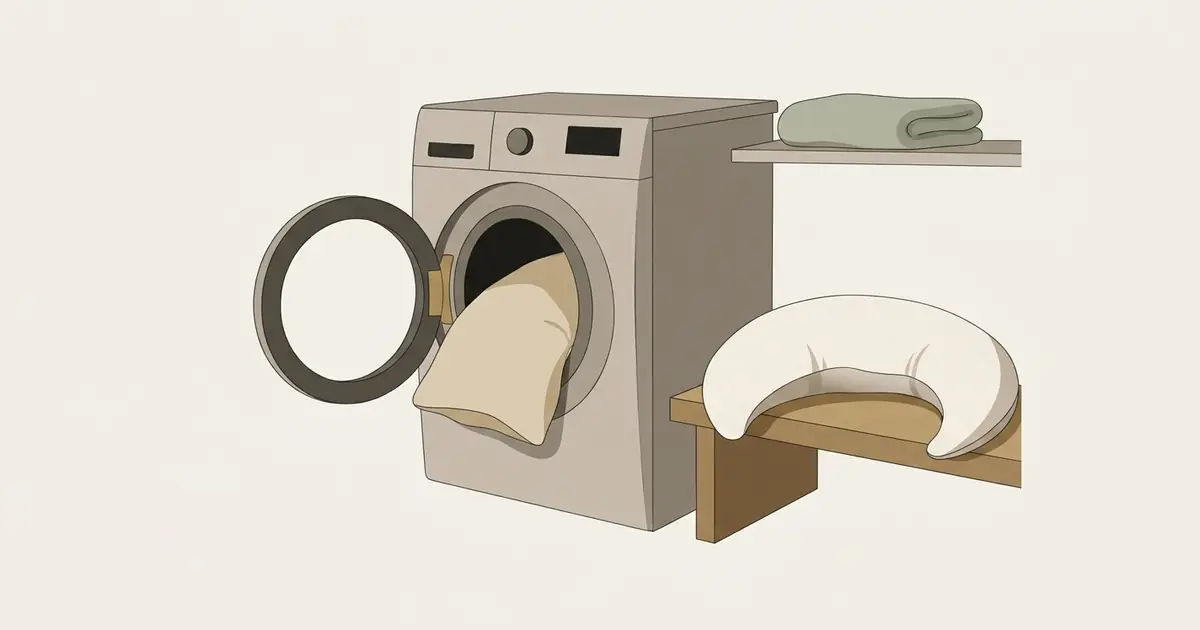
Wash the cover according to the label before storage. For most removable zip-off covers, that means machine washing on a gentle cold cycle. The fill should also be cleaned following the manufacturer's method — shredded memory foam in particular requires attention because the pieces need to dry all the way through, not just on the outer surface 2.
Drying is not complete when the cover feels dry to the touch. Allow extra time for the fill to dry fully — tumble drying may need multiple cycles, and the interior fill may still hold moisture even when the exterior seems ready 1. If you are air-drying, use a well-ventilated space and give the pillow adequate time before moving to the next step. Some pillows can also be dried outside or in a well-ventilated spot, depending on the manufacturer's guidance 1. See how to wash a body pillow for a full cleaning walkthrough.
It is worth removing the cover and washing it separately from the fill. A cover laundered and dried on its own is easier to inspect for any remaining damp patches, and it lets you confirm both components are fully ready before they go into storage together.
Choose a suitable bag and location
Once the pillow is clean and dry, the goal of the bag is to protect it from dust and pests without trapping moisture. A breathable fabric bag — such as a cotton storage bag or the type often sold for duvets — is a better default than a sealed plastic bin for most body pillows, because it allows minor humidity changes to pass through rather than condensing inside.
The location matters as much as the bag. A cool, dry indoor space — a wardrobe, a linen cupboard, or under-bed storage in a climate-controlled room — is preferable to a loft, garage, or basement, where temperature swings and higher humidity are common. Hot, humid environments are generally unfavorable for both fabric and foam, and temperature variation over the storage period is worth factoring in when you choose a spot 3. If you use an under-bed container, check that it sits off the floor rather than directly on cold concrete, which can cause condensation on the underside of the bag.
Avoid storing the pillow in direct or prolonged sunlight, which can degrade both fabric and foam over time. A dark, stable indoor location is the most straightforward choice for long-term storage.
The table below summarizes common storage locations and their suitability:
| Location | Temperature stability | Humidity risk | General suitability |
|---|---|---|---|
| Indoor wardrobe or cupboard | Good | Low | Well suited |
| Under-bed storage (climate-controlled room) | Good | Low | Well suited |
| Basement | Variable | Often high | Use only if dry and well-ventilated |
| Loft or attic | Poor (seasonal swings) | Variable | Not recommended |
| Garage | Poor (seasonal swings) | Often high | Not recommended |
Check whether compression is allowed
Compression storage — rolling the pillow tightly or using a vacuum bag — reduces the space a large body pillow needs significantly, but it is not appropriate for all fills.
Shredded memory foam is particularly vulnerable. The fill pieces can be permanently deformed by sustained compression, and memory foam can break down if it is not handled correctly 2. If the manufacturer's instructions do not explicitly permit vacuum compression or tight rolling, do not use those methods. Checking before compressing rather than after is the only way to avoid damage that cannot be undone.
Polyester fiberfill pillows generally tolerate some compression better, but even with those, extended vacuum storage can cause uneven clumping that does not fully recover. See memory foam vs polyester body pillows for more on how fill type affects handling and care.
If you need to reduce the footprint of the pillow without compressing the fill, a crescent body pillow can often be folded loosely along its curve and placed in a large fabric bag without applying sustained pressure to the foam. That approach keeps the pillow manageable for storage without risking permanent fill damage.
Here is a storage readiness checklist to work through before you seal the bag:
- [ ] Read the care label and any printed storage instructions
- [ ] Wash the cover according to the label
- [ ] Clean the fill following the manufacturer's method
- [ ] Confirm the fill is completely dry all the way through, not just on the surface
- [ ] Confirm the cover is completely dry
- [ ] Store the cover separately or folded loosely alongside the fill — never sealed in damp
- [ ] Choose a breathable bag rather than a sealed plastic container
- [ ] Confirm whether compression is permitted before rolling or vacuum-sealing
- [ ] Select an indoor, climate-controlled location away from direct light
- [ ] Note the storage date so you can schedule a periodic check
Inspect and air only as directed before reuse
When you bring the pillow back out of storage, do not put it straight onto the bed. Give yourself a short inspection and airing period first.
Unfold or unroll the pillow and check the cover for any visible staining, discoloration, or mold. Check the fill through the outer fabric for any unusual odor or for areas that feel permanently flat or lumpy. If there is an odor that does not dissipate after airing, or visible mold growth, do not use the pillow — clean it again fully following the care label, or consider whether it needs to be replaced.
If the pillow has been stored flat or lightly compressed, allow time for the fill to recover to its normal volume before you sleep on it. Shredded memory foam typically needs a few hours to expand back after any period of compression 2. This is similar to the recovery period you would allow when unboxing a compressed body pillow for the first time.
Airing should follow whatever method the manufacturer describes — typically in a well-ventilated room rather than in prolonged direct sunlight, which can degrade both fabric and foam. Once the fill has recovered and you are satisfied there is no odor or visible damage, fit the cover, check that the zip closes cleanly, and the pillow is ready to use again. If the fill feels uneven after airing, and your pillow has an adjustable fill like the Cove Classic or Cove Mini, open the inner zip and redistribute the pieces before replacing the cover.
More in this series: start with the body pillow buying guide and returning a body pillow: a practical packing checklist.
From Cove


Questions
It depends on the fill. Vacuum bags work by removing air and compressing the contents, which can permanently damage foam by breaking down its cell structure. For shredded memory foam pillows in particular, the manufacturer's guidance should be your first reference — if the label or documentation does not explicitly allow vacuum compression, avoid it. Polyester fiberfill pillows are generally more tolerant of compression, but even then, extended vacuum storage can cause the fill to clump rather than spring back evenly. If you are unsure, a loose breathable bag is the safer default.
Lofts and garages are often the riskiest storage spots for a body pillow. Both spaces can experience wide temperature swings and high humidity, which encourages mildew growth inside the fill even when the pillow feels dry to the touch. Dust, insects, and rodents are also more likely to be present than in a climate-controlled indoor room. If an indoor cupboard, wardrobe, or under-bed space is available, use it instead. If a garage or loft is your only option, seal the pillow in a robust bag, keep it off the floor, and check it more frequently for moisture or pest activity.
Storing the cover separately is worth doing for two reasons. First, a removable cover can be laundered and fully dried more easily on its own than when fitted to the pillow, and any residual moisture in the cover can transfer to the fill if they are stored together. Second, removing the cover lets you inspect both surfaces before you pack them away. Once both are clean and dry, you can fold the cover loosely inside or alongside the pillow in the same storage bag, or keep it with your other bedding. Either approach works as long as everything is dry before it goes into storage.
Storage duration itself does not automatically degrade a pillow, provided the conditions are correct. What matters more is whether the fill has been kept dry, protected from compression it was not designed to withstand, and shielded from heat, pests, and prolonged sunlight. A pillow stored in a cool, dry, dark indoor space in a breathable bag can remain in usable condition for many months. When you bring it back out, check for odor, visible mold or staining, and whether the fill recovers to its normal volume after a few hours of airing.
Washing before storage is strongly recommended rather than optional. Body oils, moisture, and skin cells that have accumulated in the cover and fill will not simply sit inert during storage — they can contribute to odor and microbial growth over time. Follow the care label for the correct method: the Cove Classic and Cove Mini both have zip-off covers that are machine washable on cold, which makes pre-storage cleaning straightforward. The fill should be cleaned according to manufacturer instructions before it is sealed away, and everything must be thoroughly dry before storage begins.
Sources
- How to wash pillows, Sleep Foundation. Accessed October 27, 2026.
- How to wash pillows, Sleep Foundation. Accessed October 27, 2026.
- Why do I get so hot when I sleep?, Sleep Foundation. Accessed October 27, 2026.
About the author
The Cove editorial team is the group at Cove that writes our guides. We write them from published guidance and our own product testing, and link every source. About the team
Related guides
 How to wash a body pillow and its cover
: wash the cover cold, spot clean the pillow, dry it fully. Steps for plain, heated and cooled pillows in 5 minutes.
 Memory foam vs polyester body pillows
: support, weight, warmth, washing and lifespan compared, with the 1 to 2 years the Sleep Foundation gives a pillow.
 Unboxing a body pillow: what to check before the first night
Learn how to open a new body pillow, check your order, follow expansion steps, and record any damage or missing parts before your trial period starts.


