
The complete guide to sleeping on your side
How to sleep on your side: line up your head, shoulders and hips, choose the right pillow height, and support your knees and back.
By Cove editorial team · Updated October 26, 2026 · 7 min read · Editorial standards

Key takeaways
- Keep your ear, shoulder and hip in one straight line, with knees slightly bent.
- Match pillow height to the gap between your neck and the outside of your shoulder.
- Support the top knee and arm so your hips and shoulders do not roll forward.
- Either side is fine for most people; reflux and pain can change that.
- See a GP if pain stops normal activities or has not improved after 2 weeks.
To sleep on your side well, keep your ear, shoulder and hip in one line with your knees slightly bent. Use a head pillow that fills the gap between your neck and shoulder, and put support between your knees. The Sleep Foundation says a small pillow between the knees may take strain off the lower back2.
What good side sleeping looks like
Picture a straight line from the middle of your ear, through the point of your shoulder, to the top of your hip. In a good side position that line stays roughly level with the mattress all night. Your knees are bent a little, one on top of the other, and your arms are in front of you rather than trapped under your body.
Three things usually break that line. Your head drops toward the mattress or is pushed up toward the ceiling. Your top knee falls forward and down, which twists your pelvis. Your top shoulder rolls forward, which pulls on the upper back and the front of the shoulder.
Each fix below targets one of those breaks. You can set all five up in about 3 minutes, and none of them needs special equipment.
Fix 1: get your head pillow height right
The Sleep Foundation suggests choosing a pillow with a loft, or thickness, that matches the distance between your neck and your shoulder2. That keeps your whole spine in a neutral line. For most people this is a firmer or thicker pillow than a back sleeper would choose.
A quick test takes 30 seconds. Lie on your side and ask someone to look at you from behind, or take a photo with your phone on a timer. If your nose points down toward the mattress, the pillow is too low. If your chin tilts up, it is too high.
- Narrow shoulders: start with a medium pillow and add a folded towel if needed.
- Broad shoulders: start with a high or firm pillow.
- Soft mattress: you sink further, so you often need slightly less pillow.
- Firm mattress: your shoulder sinks less, so you often need slightly more.
Fix 2: support your knees
When your top knee drops onto the mattress, the top hip rotates forward and the lower back twists. Putting a pillow between the knees keeps the top leg level with the hip. The Sleep Foundation recommends this for taking strain off the lower back2.
The pillow should be thick enough that your top knee sits at the same height as your top hip. A thin cushion lets the knee keep dropping, and a very thick one pushes the leg up and can strain the outside of the hip. Our guide to sleeping with a pillow between your knees covers thickness and the three common options.
If you wake with sore hips, the knee pillow is usually the first thing to try. More detail is in how to sleep on your side without hip pain.
Fix 3: give your top arm somewhere to rest
With nothing in front of you, the top arm falls forward across your body. That drags the shoulder blade around and can leave the front of the shoulder sore by morning. Hugging a pillow gives the arm a resting place at roughly shoulder height.
The lower arm needs attention too. Lying directly on the point of the shoulder squeezes it, so bring that shoulder slightly forward so you rest more on the shoulder blade. Never sleep with the lower arm under your pillow and head for hours, which can leave the hand numb.
If one shoulder is already painful, lie on the other side where you can. Our guide on why your shoulder hurts when you sleep on your side walks through three setups.
Fix 4: stop the roll forward and back
Most people shift position many times a night. On your side, the common drift is forward onto the stomach, or back onto the back. A pillow in front of your chest and knees blocks the forward roll, and one behind your back blocks the backward roll.
For people with lower back pain, the Sleep Foundation describes side sleeping with knees slightly bent as a position that may help2. A pillow behind you can make that position easier to hold. See side sleeping and lower back pain for three setups.
Fix 5: set up the room
Comfort matters as much as position. The Sleep Foundation puts the best bedroom temperature at around 65 °F (18.3 °C), with most doctors suggesting 65 to 68 °F6. Side sleepers who hug pillows often run warm, so a breathable cover and lighter bedding help.
- Keep the room dark and quiet, and keep the thermostat in that range if you can.
- Use a mattress that lets your shoulder and hip sink a little without sagging in the middle.
- Keep pillows where you can find them in the dark, so you do not wake fully to rearrange.
The five fixes at a glance
| Problem | What you notice | Fix |
|---|---|---|
| Head too low or high | Stiff neck on waking | Pillow height that fills the neck to shoulder gap |
| Top knee drops | Sore hip or lower back | Pillow between the knees, level with the hip |
| Top arm falls forward | Sore front of shoulder | A pillow to hug at chest height |
| Rolling onto stomach or back | Waking in a different position | Support in front and behind |
| Room too warm | Waking hot, kicking off covers | 65 to 68 °F, breathable layers |
Which side should you sleep on
For most people, either side is fine, and switching sides through the night is normal. The Sleep Foundation notes that left-side sleeping may help people with acid reflux, while right-side sleeping may be preferred by some people with heart conditions1. If you have heartburn, the NHS also suggests raising the head of the bed by around 10 to 20 cm and not eating within 3 or 4 hours of bed5.
Our guide to left side vs right side sleeping explains the evidence and the two cases where the choice matters most.
When pain is the reason you are reading this
Better positioning helps many people, but it does not replace medical advice. The NHS suggests seeing a GP if hip pain is affecting your sleep, stops normal activities, or has not improved after 2 weeks of treating it at home3. It gives similar advice for shoulder pain that has not started to feel better after 2 weeks4.
For back pain, the NHS advises staying active rather than staying in bed for long periods, and suggests a heat pack wrapped in a tea towel for stiffness or muscle spasms7. Any sudden, severe or worsening pain, or pain with fever, needs urgent care.
A sample setup for one night
1. Pick the head pillow that passed the 30 second photo test. 2. Lie on your side with knees bent about 30 to 45 degrees. 3. Slide a pillow between the knees and down to the ankles if you can, so the whole top leg is supported. 4. Hug a pillow at chest height and rest the top arm on it. 5. If you roll back in your sleep, wedge a pillow behind your back.
A crescent body pillow does steps 3 to 5 with one piece. The Cove Classic is 52 inches tip to tip, and The Cove Mini is 36 inches for smaller frames or travel. Both have a shredded memory foam fill you can adjust through an inner zip, and both come with a 100 night trial. Our size guide helps you choose by height.
Common mistakes
- Using the same flat pillow you used as a back sleeper. Side sleeping needs more height to fill the shoulder gap.
- Tucking the lower arm under the head pillow. It feels secure, but it squeezes the shoulder and can leave the hand numb.
- Lying with the top leg straight. A straight top leg slides forward and twists the pelvis just like a dropped knee.
- Curling up very tightly. A gentle bend at the hips and knees is easier on the back than knees pulled to the chest.
- Changing everything at once. If you swap the mattress, pillow and position in one night, you will not know which change helped.
Give it a week
A new position can feel odd for the first few nights, because your body is used to the old one. Try the setup for 7 nights before judging it, and change one thing at a time. If your neck still aches, adjust the head pillow first, because that is the most common cause.
Keep a simple note each morning: which side you woke on, where you felt stiff, and what you changed the night before. After a week the pattern is usually clear. If pain is getting worse rather than better, stop and speak to a GP or physiotherapist.
Guides in this series
From Cove


Questions
For many adults it is a good default. The Sleep Foundation notes side sleeping can help relieve some pain and reduce snoring. The best position is the one that keeps your spine neutral and lets you sleep without pain.
High enough to fill the gap between your neck and the outside of your shoulder, so your head is level with your spine. Broad shoulders usually need a higher pillow than narrow ones.
Most people change position many times a night. A body pillow in front of you makes rolling forward onto your stomach less likely, and one behind you can stop you rolling onto your back.
It can if your lower shoulder takes too much weight or the top arm pulls forward. Bring the lower shoulder slightly forward and rest the top arm on a pillow. Our shoulder guide covers this in detail.
No. A firm pillow between the knees and another to hug do the same job. A single body pillow is easier because it stays in place as you move.
Sources
- Side sleeping, Sleep Foundation. Accessed October 26, 2026.
- What is the best sleeping position?, Sleep Foundation. Accessed October 26, 2026.
- Hip pain in adults, NHS. Accessed October 26, 2026.
- Shoulder pain, NHS. Accessed October 26, 2026.
- Heartburn and acid reflux, NHS. Accessed October 26, 2026.
- The best temperature for sleep, Sleep Foundation. Accessed October 26, 2026.
- Back pain, NHS. Accessed October 26, 2026.
About the author
The Cove editorial team is the group at Cove that writes our guides. We write them from published guidance and our own product testing, and link every source. About the team
Related guides
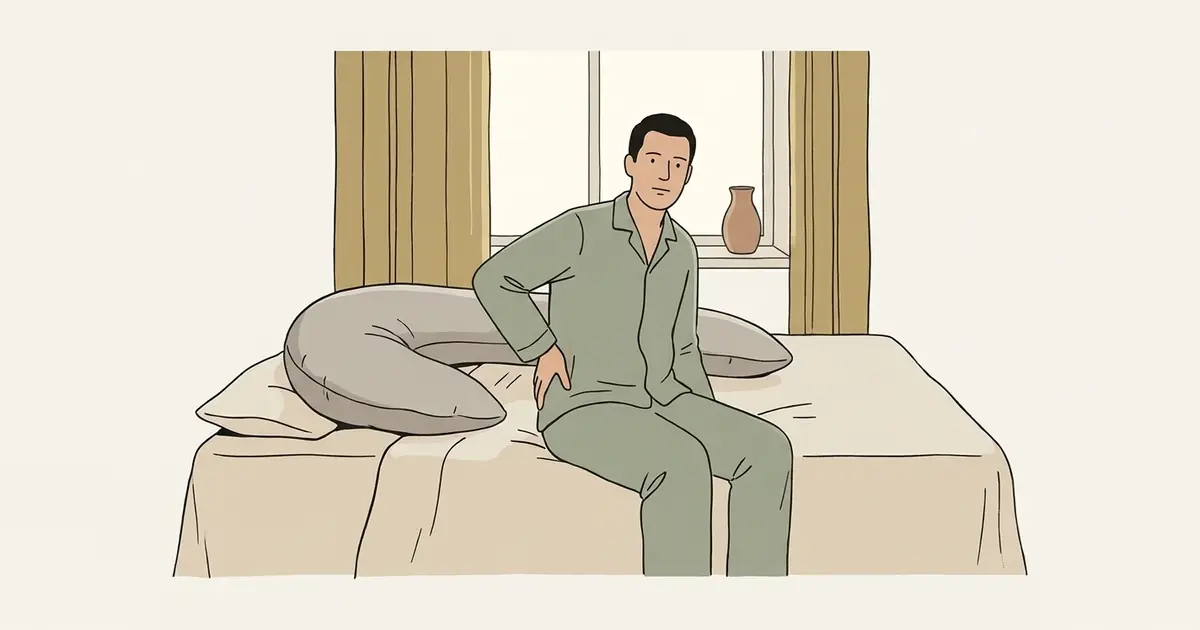 How to sleep on your side without hip pain
Side sleeping hip pain often starts with the top knee dropping. A pillow between the knees eases hip pressure. Four setup steps and a 100 night trial.
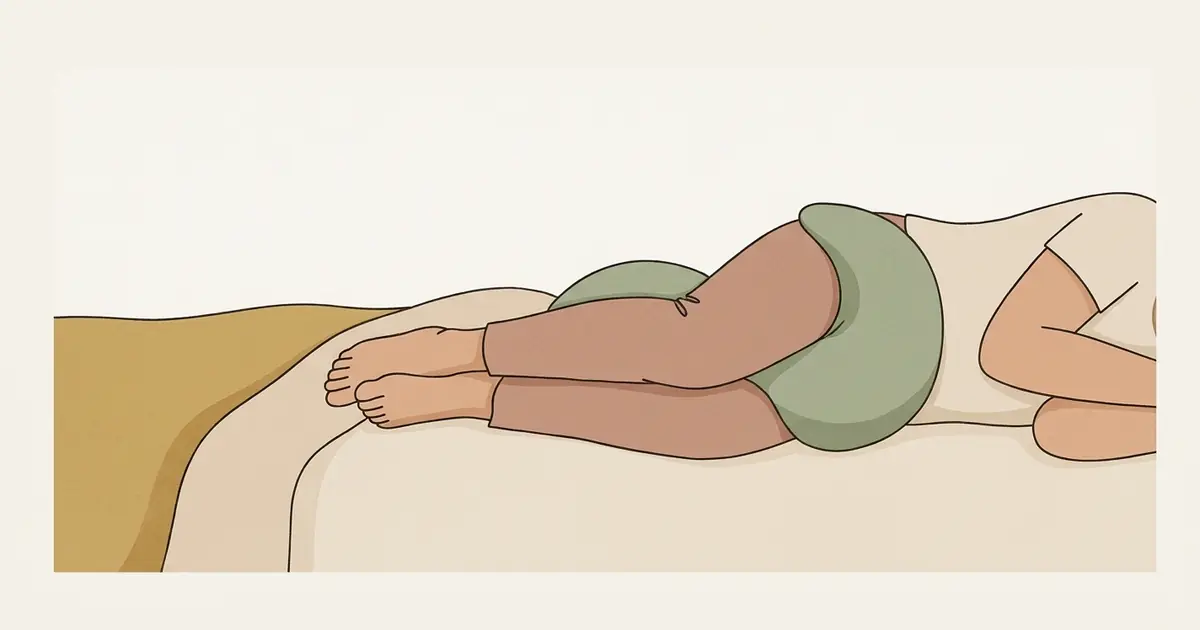 Should you sleep with a pillow between your knees
Sleeping with a pillow between your knees can relieve hip pressure and keep your legs level. Who it helps, how thick it should be, and 3 options.
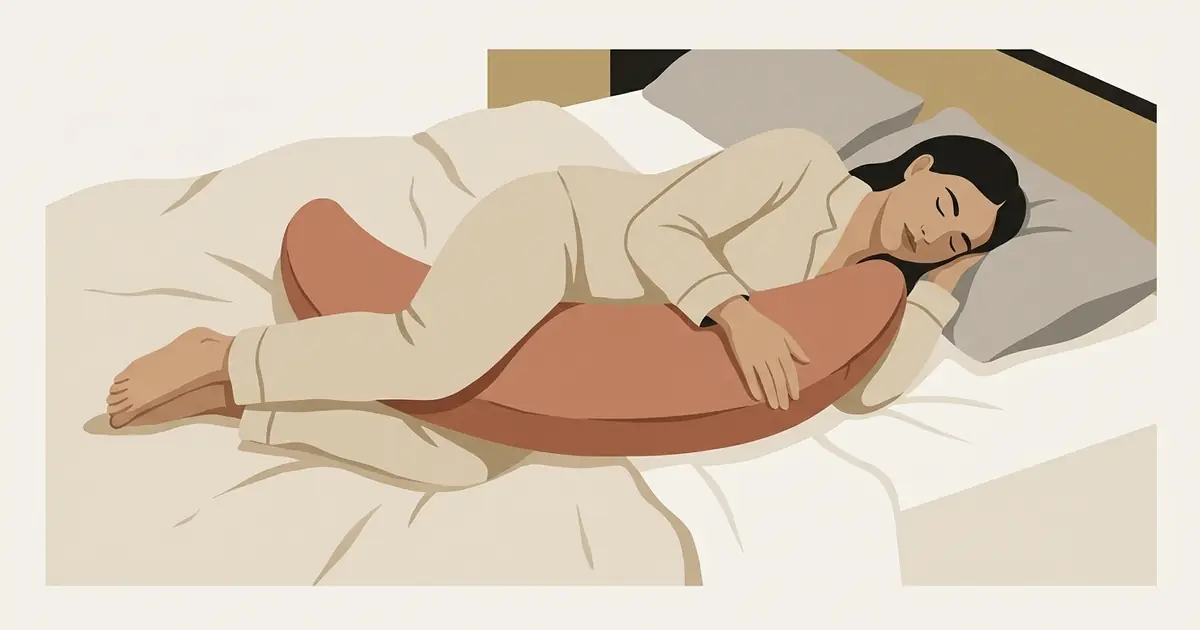 Why your shoulder hurts when you sleep on your side
Why your shoulder hurts on your side and the pillow changes that help: lower arm position, head pillow height and 3 setups. See a GP after 2 weeks of pain.


