
How to sleep on your side without hip pain
Side sleeping hip pain often starts with the top knee dropping.
By Cove editorial team · Updated October 26, 2026 · 5 min read · Editorial standards

Key takeaways
- Hip pain on your side often comes from the top knee dropping and twisting the pelvis.
- A pillow between the knees keeps the top leg level with the hip.
- A mattress that lets the hip sink a little spreads the pressure.
- See a GP if hip pain affects sleep or has not improved after 2 weeks.
Side sleeping hip pain usually comes from the top knee dropping toward the mattress, which twists the pelvis and loads the outside of the hip. Keeping your knees stacked with a pillow between them, and letting the lower hip sink slightly into the mattress, often helps. The NHS advises seeing a GP if hip pain affects your sleep2.
Why your hip hurts on your side
Two hips, two different problems. The lower hip carries weight, so a mattress that is too firm presses on the bony point at the outside of the hip. The top hip has the opposite problem: nothing holds it up, so the leg falls forward and down, twisting the pelvis and stretching the tissues at the outside of the hip.
The NHS lists several causes of hip pain in adults, including bursitis, a common cause of pain at the outside of the hip that can be worse when lying on that side2. Positioning will not fix every cause. It does remove one common source of strain that repeats for 7 or 8 hours every night.
Step 1: stack your knees
Lie on your side with both knees bent about 30 to 45 degrees, one directly on top of the other. Then put a pillow between them. The Sleep Foundation says a small pillow between the knees may take additional strain off the lower back1, and the same alignment keeps the top hip from rolling forward.
The pillow should hold the top knee at the same height as the top hip. If your knee still slopes down, the pillow is too thin. If the knee is pushed up higher than the hip, it is too thick.
Our guide to sleeping with a pillow between your knees compares a rolled towel, a small knee pillow and a body pillow.
Step 2: support the whole top leg
A small cushion between the knees supports the knee but leaves the ankle hanging. That lets the shin rotate inward, which can still twist the hip slightly. A longer pillow that runs from the knee down toward the ankle supports the whole leg.
This is also where small knee pillows tend to fail. They slip out when you shift, and the knee drops again at 3 a.m. A body pillow that runs from your chest down to your knees is harder to lose.
Step 3: check your mattress
The lower hip needs to sink a little. On a very firm mattress the hip and shoulder take all the pressure. On a mattress that sags in the middle, the pelvis drops lower than the shoulders, which bends the spine sideways.
- Lie on your side and slide a flat hand under your waist. A small gap is normal.
- If you cannot fit your hand at all, the mattress may be sagging or too soft.
- If the gap is large and your hip feels pressed, the mattress may be too firm.
A topper can add give to a firm mattress. Nothing fixes a sag except a new mattress or a firmer base.
Step 4: take care of the other side
If one hip is sore, lie on the other side where you can, with a pillow between the knees so the sore top hip is supported. If you keep rolling onto the sore side during the night, a pillow behind your back makes that roll harder.
If both hips hurt, alternate sides through the night and use support between the knees on both. Our complete guide to sleeping on your side shows the full setup, including head and arm support.
Setups compared
| Setup | Supports | Stays in place | Best for |
|---|---|---|---|
| Rolled towel | Knees only | Poorly | A night away from home |
| Small knee pillow | Knees | Fairly | Mild hip ache, warm sleepers |
| Long pillow, knee to ankle | Whole top leg | Fairly | Hip pain on waking |
| Crescent body pillow | Knees, leg, chest and arm | Well | Hip pain plus shoulder or back strain |
What to do during the day
What you do in the day can affect how the hip feels at night. Long periods sitting in one position, or standing with your weight on one leg, load the same tissues you lie on at night. The NHS hip pain page lists the self-care steps it suggests trying for 2 weeks before seeing a GP2.
For general back and hip stiffness, the NHS suggests a heat pack wrapped in a tea towel can relieve stiffness or muscle spasms4. Do not sleep with a hot water bottle against your skin.
When to see a GP
The NHS suggests seeing a GP if hip pain is stopping you from doing normal activities or affecting your sleep, if the pain is getting worse or keeps coming back, if it has not improved after treating it at home for 2 weeks, or if you have hip stiffness for more than 30 minutes after waking up2. Severe pain, pain after a fall or injury, or pain with a fever needs urgent care rather than a new pillow.
A physiotherapist can also look at how you move and suggest exercises. Bring a note of which side you sleep on and what you have tried.
Choosing one pillow for the job
If you keep losing a knee pillow, a crescent body pillow solves the slipping problem. The Cove Classic is 52 inches tip to tip, which suits most adults from about 5 ft to 6 ft 4 in, so one end sits between the knees while the curve supports your chest and arm. The shredded memory foam fill adjusts through an inner zip if the knee end feels too thick or too thin.
It comes with a 100 night trial, which is about the time it takes to know whether a change in setup is working for you. See what size body pillow you need if you are shorter or taller.
A one week plan
1. Nights 1 to 3: knees stacked, pillow between them, lying on the side that hurts least. 2. Nights 4 to 5: lengthen the support so it reaches the ankle. 3. Nights 6 to 7: add a pillow behind your back if you are still rolling. 4. Day 8: note what changed. If nothing has, or the pain is worse, book a GP appointment.
Changing one thing at a time tells you what actually helps. Side sleeping is a good position for many people3, and most hip pain from position responds to small changes.
Keep reading
From Cove

Questions
Most people find it easier to lie on the side that does not hurt, with a pillow between the knees so the sore top hip is not pulled forward. If both hips hurt, support between the knees matters even more.
Give one setup about 7 nights and change one thing at a time. If pain gets worse, or has not improved after 2 weeks, the NHS suggests seeing a GP.
Not always. Side sleepers usually need enough give for the hip and shoulder to sink slightly. A mattress that is too firm can press on the hip, and one that sags lets the pelvis tilt.
The NHS lists bursitis as one possible cause of pain on the outside of the hip that can be worse lying on your side. Only a clinician can tell you the cause of your pain.
It can help by keeping the top leg level all night, which a small knee pillow sometimes fails to do because it slips out. It does not treat the cause of the pain.
Sources
- What is the best sleeping position?, Sleep Foundation. Accessed October 26, 2026.
- Hip pain in adults, NHS. Accessed October 26, 2026.
- Side sleeping, Sleep Foundation. Accessed October 26, 2026.
- Back pain, NHS. Accessed October 26, 2026.
About the author
The Cove editorial team is the group at Cove that writes our guides. We write them from published guidance and our own product testing, and link every source. About the team
Related guides
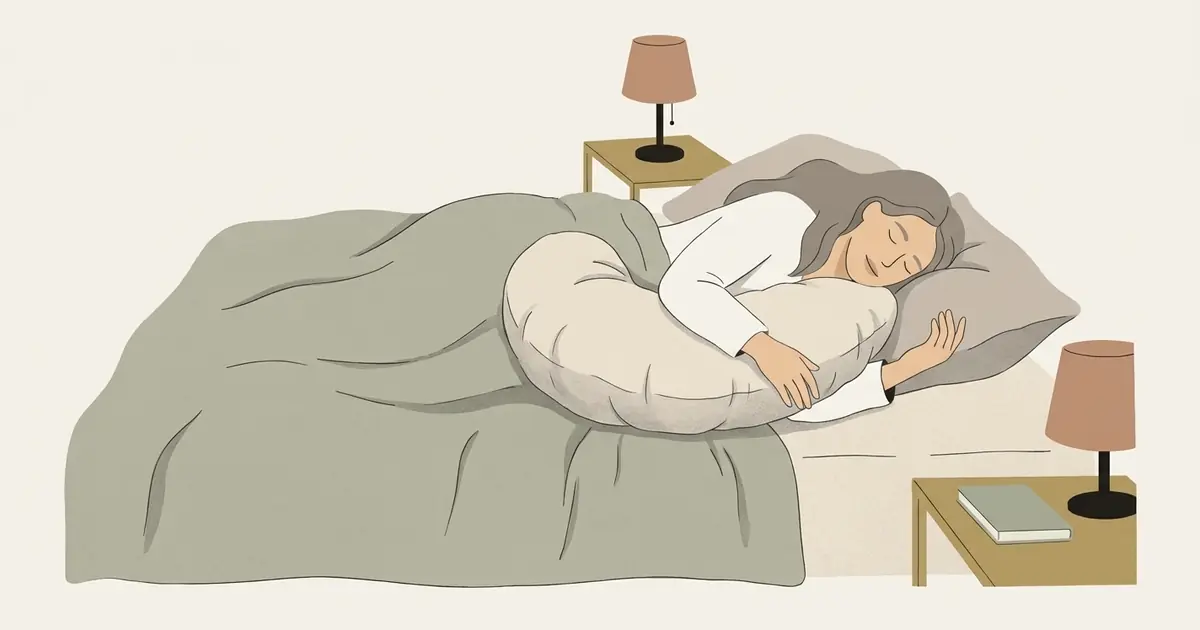 The complete guide to sleeping on your side
How to sleep on your side: line up your head, shoulders and hips, choose the right pillow height, and support your knees and back. Five fixes in 3 minutes.
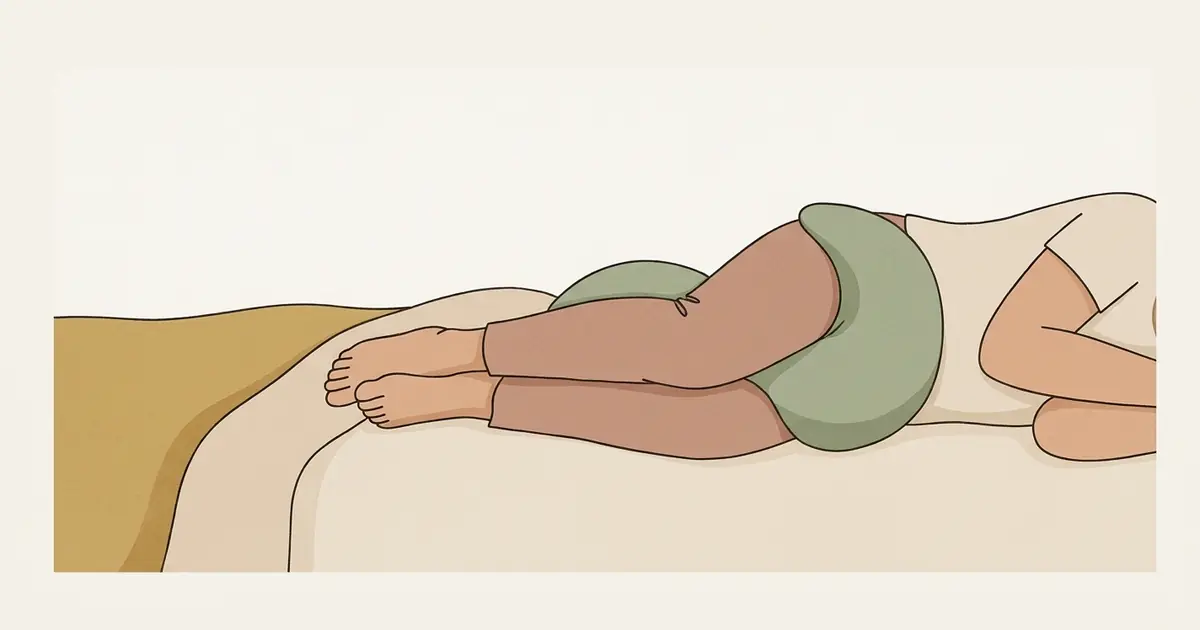 Should you sleep with a pillow between your knees
Sleeping with a pillow between your knees can relieve hip pressure and keep your legs level. Who it helps, how thick it should be, and 3 options.

