
Should you sleep with a pillow between your knees
Sleeping with a pillow between your knees can relieve hip pressure and keep your legs level.
By Cove editorial team · Updated October 26, 2026 · 4 min read · Editorial standards

Key takeaways
- A pillow between the knees keeps the top leg level, which can ease hip and lower back strain.
- It should be thick enough to hold your top knee level with your hip.
- Supporting the knee down to the ankle stops the shin twisting the hip.
- A body pillow stays in place better than a loose knee pillow.
Yes, if you sleep on your side and wake with sore hips, knees or lower back. A small pillow between your knees may take strain off the lower back, according to the Sleep Foundation1. It keeps the top leg level with the hip so the pelvis does not twist. A long body pillow stays in place all night.
What the pillow actually does
On your side, your top leg has nothing to rest on except the bottom leg. Gravity pulls the top knee forward and down until it reaches the mattress. That rotates the pelvis, twists the lower back slightly, and presses one knee onto the other.
A pillow between the knees fills that gap. Your top thigh stays roughly parallel to the mattress, your pelvis stays square, and your knees are no longer bone on bone. The Sleep Foundation recommends side sleeping with knees slightly bent and a small pillow between them as a position that may help the lower back1.
Who it helps most
- Side sleepers who wake with a sore hip. See how to sleep on your side without hip pain.
- People with lower back ache that is worse in the morning. See side sleeping and lower back pain.
- Anyone whose knees knock together or feel bruised on waking.
- People with wide hips relative to their knees, where the top leg slopes down more steeply.
It also helps people who hug a pillow to their chest, because a long pillow can do both jobs. More in why your shoulder hurts when you sleep on your side.
How thick it should be
The goal is simple: your top knee at the same height as your top hip. The right thickness depends on the width of your hips and how far your lower leg sinks into the mattress.
1. Lie on your side with knees bent and stacked. 2. Ask someone to look from the foot of the bed, or prop your phone up and take a photo. 3. Check the line from your hip to your knee. It should be close to level. 4. Adjust: add a folded towel if the knee slopes down, or use something thinner if it points up.
Wider hips usually need a thicker pillow than narrow hips, and a soft mattress needs a little less than a firm one, because the lower leg sinks further.
Knee only, or knee to ankle
A small knee cushion supports the knee and leaves the foot hanging. The shin then rotates inward, which can still pull on the hip. A longer pillow that runs from the knee to the ankle supports the whole top leg and keeps it parallel to the bottom one.
If you have tried a knee pillow and still wake with a sore hip, extending the support down to the ankle is the next thing to try.
Three options compared
| Option | Thickness | Stays in place | Good for | Drawback |
|---|---|---|---|---|
| Rolled towel | Adjustable | Poorly | A night away | Unrolls and goes flat |
| Small knee pillow | Fixed | Fairly | Mild hip ache | Slips out when you turn |
| Body pillow | Adjustable fill | Well | Hip, back and shoulder together | Takes more bed space |
Making it stay put
The most common complaint about knee pillows is that they are on the floor by morning. Most people change position several times a night, and a small cushion goes wherever the legs go. A pillow you can also hug is held in place by your arms as well as your knees.
A crescent body pillow works this way: one tip sits between the knees, the curve runs up your front, and you rest your top arm on it. The Cove Classic is 52 inches tip to tip, and The Cove Mini is 36 inches for smaller frames or travel. The shredded memory foam fill adjusts through an inner zip, so you can make the knee end thinner or thicker.
Getting used to it
The first few nights can feel strange, especially if you have slept without support for years. Give it about a week before deciding. If your hips feel stretched rather than relaxed, the pillow is probably too thick.
Change one thing at a time: thickness first, then length, then whether you add support in front of the chest. Keep a short note each morning of how your hips and back feel.
Away from home
You do not need to carry your bedroom with you. On a night away, roll a bath towel lengthwise and secure it with two hair ties, or fold a spare hotel pillow in half. On long flights or in the car, a small cushion between the knees helps less, because you are sitting rather than lying, so save it for the hotel bed.
When a pillow is not enough
A pillow changes position, not the underlying cause. The NHS suggests seeing a GP if hip pain affects your sleep or normal activities, keeps coming back, or has not improved after 2 weeks of home treatment3. Stiffness that lasts more than 30 minutes after waking is another reason to get checked3.
Side sleeping itself suits many people. The Sleep Foundation notes it can help relieve some pain and reduce snoring2. A knee pillow is one of the simplest ways to make it more comfortable.
Putting the full setup together
Knee support is one of five fixes for side sleepers. The others are head pillow height, arm support, blocking the roll forward or back, and room temperature. They are all in the complete guide to sleeping on your side.
Keep reading
From Cove


Questions
No. If it is the right thickness it keeps your legs level. If it feels awkward, try a thinner one, or give it a few nights to feel normal.
Both, if you can. Support only at the knee lets the lower leg hang and rotate. A longer pillow that reaches the ankle supports the whole top leg.
Back sleepers usually put the pillow under the knees rather than between them, which many find eases the lower back.
A knee pillow does little for stomach sleepers. Hugging a body pillow on your side can be an easier way to move away from stomach sleeping.
Use a longer pillow you can also hug, so your arms help hold it. A body pillow that runs from chest to knees is much harder to lose in the night.
Sources
- What is the best sleeping position?, Sleep Foundation. Accessed October 26, 2026.
- Side sleeping, Sleep Foundation. Accessed October 26, 2026.
- Hip pain in adults, NHS. Accessed October 26, 2026.
About the author
The Cove editorial team is the group at Cove that writes our guides. We write them from published guidance and our own product testing, and link every source. About the team
Related guides
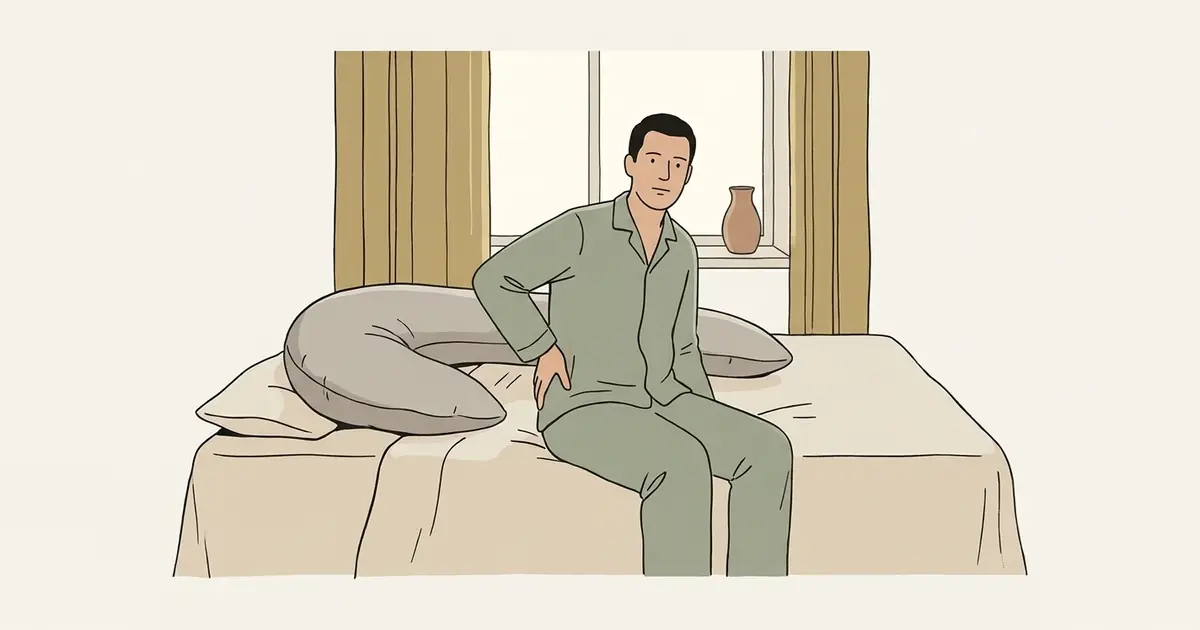 How to sleep on your side without hip pain
Side sleeping hip pain often starts with the top knee dropping. A pillow between the knees eases hip pressure. Four setup steps and a 100 night trial.
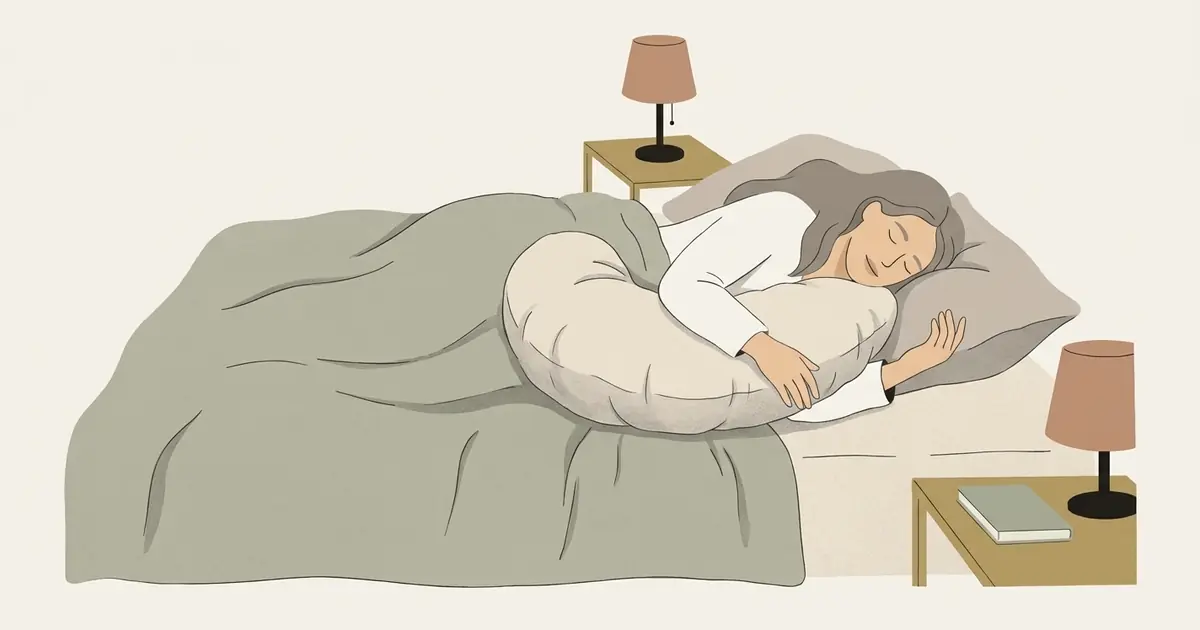 The complete guide to sleeping on your side
How to sleep on your side: line up your head, shoulders and hips, choose the right pillow height, and support your knees and back. Five fixes in 3 minutes.

