
Body pillow buying guide
How to choose a body pillow: shape first, then length, fill and cover.
By Cove editorial team · Updated October 26, 2026 · 8 min read · Editorial standards

Key takeaways
- Choose the shape first: straight, crescent, U or J. It decides what the pillow can support.
- Match length to your height and bed width; 52 inches suits most adults.
- Fill decides feel, weight and washing: shredded foam, polyester fibre or solid foam.
- A removable, machine washable cover matters more than most people expect.
- Use a trial period to test it for at least a few weeks.
To choose a body pillow, decide on the shape first, then the length, the fill and the cover. Shape decides what it supports, length decides whether it reaches your knees, and fill decides how it feels and washes. The Sleep Foundation notes a pillow between the knees may take strain off the lower back1, which is the main job.
What a body pillow is for
A body pillow replaces two or three separate pillows: one between the knees, one to hug, and sometimes one behind the back. For side sleepers, that keeps the top knee level with the hip and gives the top arm a resting place at chest height. The Sleep Foundation describes side sleeping with knees slightly bent and a small pillow between them as a position that may help the lower back1.
It is not a medical device, and it does not treat pain. What it does well is hold a good position for 7 or 8 hours, which separate pillows rarely manage because they slide away when you move.
Step 1: choose the shape
Shape matters more than any other choice, because it decides which parts of the body the pillow can reach at the same time.
| Shape | Supports | Bed space | Stays in place | Best for |
|---|---|---|---|---|
| Straight | Knees and chest, one side | Narrow | Fairly | Small beds, simple needs |
| Crescent | Knees, chest, arm; tips can tuck behind | Medium | Well | Side sleepers who move |
| J shape | Head, chest, knees on one side | Medium | Well | People who want head support built in |
| U shape | Both sides of the body at once | Wide | Very well | Single sleepers in a large bed |
A straight pillow is the simplest, and it works if you mostly stay still. A crescent curves around your front, so it is harder to push away and one tip can sit between the knees while the middle supports your chest. U shapes surround you, which some people love, but they take most of a queen bed and make sharing a bed awkward.
Our comparison of body pillow shapes has diagrams of each.
Step 2: choose the length
The pillow needs to reach from your chest to at least your knees, ideally further. Too short, and the knee end does not reach. Too long, and the extra length bunches up or hangs off the bed.
- Most adults: around 52 inches. That covers chest to knees for heights from about 5 ft to 6 ft 4 in.
- Smaller frames, the sofa or travel: around 36 inches.
- Very tall people: check the measurement from your armpit to your knee before buying.
Bed width matters too. A long straight pillow lies along the bed, but a crescent or U shape uses width. Our guide to what size body pillow you need has a table by height and bed size.
Step 3: choose the fill
Fill decides how firm the pillow feels, how much it weighs, whether you can adjust it and how you clean it.
| Fill | Feel | Adjustable | Washing | Weight |
|---|---|---|---|---|
| Shredded memory foam | Supportive, molds slowly | Often, through a zip | Often hand wash; check label | Heavier |
| Polyester fibre | Soft, springy | Rarely | Often machine wash | Light |
| Solid memory foam | Firm, fixed shape | No | Spot clean only | Heavy |
| Microbeads | Moves freely | No | Varies | Light |
The Sleep Foundation says solid memory foam pillows should not be machine washed because the foam can crack or degrade, while shredded memory foam pillows can often be washed following the maker's instructions2. Polyester is usually the easiest to wash and the lightest, but it flattens faster under the knee. The full comparison is in memory foam vs polyester body pillows.
Adjustable fill is worth having. Being able to remove a handful of foam from the knee end, or add it to the chest section, solves most fit problems without buying a new pillow.
Step 4: choose the cover
You will wash the cover far more often than the pillow, so it matters. Check three things:
1. It zips off completely, without wrestling the pillow out. 2. It is machine washable, and says at what temperature. 3. A spare is available, so you are not without a cover on wash day.
The fabric affects warmth. The Sleep Foundation puts the best bedroom temperature at around 65 to 68 °F3, and a body pillow adds a warm surface against your front. A breathable woven cover feels cooler than a thick plush one, but do not expect any cover to cool you on its own.
Step 5: think about weight and handling
A body pillow is big, and you lift it every morning to make the bed. Shredded foam pillows at full length often weigh 10 lb or more, while polyester ones may weigh a few pounds. Heavier pillows hold their shape and stay where you put them; lighter ones are easier to move and wash.
If you have wrist or shoulder problems, or you plan to carry it between rooms, weight is worth checking on the product page.
Step 6: check the trial, warranty and care
A pillow is personal, and it takes time to get used to a new one. Look for a trial period long enough to sleep on it for several weeks, and a warranty that covers the fill going flat or lumpy. The Sleep Foundation generally suggests replacing pillows every 1 to 2 years, though well-made pillows can last up to 5 years with proper care2.
Read the care label before you buy. Our guide on how to wash a body pillow and its cover explains what each label means.
Match the pillow to how you sleep
Your sleeping habits narrow the choice quickly. Start with the position you wake up in, not the one you fall asleep in, because that is where you spend most of the night.
- You wake on your side with a sore hip: prioritise a firm knee end. Shredded foam with adjustable fill suits this.
- You wake on your stomach: choose a pillow you can hug, so rolling forward means rolling over it. A crescent or straight pillow works.
- You wake on your back: a body pillow can help you stay on your side, but if you are happy on your back, a pillow under the knees may be all you need.
- You move a lot: a curved shape stays with you better than a straight one, because it wraps around your front.
- You run warm: choose a lighter fill and a breathable cover, and keep the room cool.
- You share a small bed: choose a straight pillow or a modest crescent, and avoid a large U.
Questions to ask before buying
1. What is the length along the curve, not just the box size? 2. How much does it weigh at full size? 3. Can I adjust the fill, and how? 4. Does the cover zip off completely, and at what temperature does it wash? 5. Can I buy a spare cover? 6. How long is the trial, and who pays for returns? 7. What does the warranty cover: the fill going flat, the cover, the zip?
If a product page does not answer these, ask before you buy. A good answer to question 3 tends to matter most after the first month, when you know how the pillow really feels.
Getting the most from a new pillow
Expect an adjustment period. For the first few nights, the pillow will feel large, and you may push it away in your sleep. Put it in the same position each night, and give it at least a week before changing the fill. Then adjust one section at a time: the knee end first, the chest section second.
Who should think twice
A body pillow is not for everyone. Back sleepers usually get more from a pillow under the knees. People who sleep very hot may find a large pillow against their front too warm. If you share a small bed, a large U shape can push your partner to the edge.
Why people like hugging one
Some people simply sleep better with something to hold. Our guide to why hugging a pillow helps some people fall asleep looks at comfort, shoulder position and what to hug. The NHS lists uncomfortable beds among the common causes of insomnia5, so comfort is worth taking seriously.
A buying checklist
- Shape: does it support knees and chest at once?
- Length: does it reach from chest to knees at your height?
- Fill: firm enough for the knee, and can you adjust it?
- Cover: zips off, machine washable, spare available?
- Weight: can you lift it easily every day?
- Trial: long enough to judge it properly?
Where Cove fits
The Cove Pregnancy Pillow is a crescent at 52 inches tip to tip and 12 lb, with a shredded memory foam fill you can adjust through an inner zip. The cover is machine washable cold, and spare covers are sold separately. The Cove Pregnancy Pillow Mini is the same shape at 36 inches and 6 lb. Both come with a 100 night trial and a 2 year warranty.
Guides in this series
- What size body pillow do I need
- How to wash a body pillow and its cover
- Memory foam vs polyester body pillows
- Why hugging a pillow helps some people fall asleep
From Cove


Questions
A shape that supports the knees and the top arm at the same time. Straight pillows and crescents both do this; a crescent curves around the front of the body so it stays in place more easily.
Long enough to reach from your chest to your knees. For most adults that is around 52 inches. Shorter frames, sofas and travel suit about 36 inches.
A U supports both sides at once, which some people like, but it takes much more bed space and is harder to share a bed with. A crescent supports the front and can tuck behind you.
The Sleep Foundation generally suggests replacing pillows every 1 to 2 years, while the best pillows can last up to 5 years with proper care. Replace it sooner if it goes flat or lumpy.
Usually the cover, always check the label for the pillow itself. The Sleep Foundation says solid memory foam should not be machine washed, while shredded foam often can be, following the maker's instructions.
Sources
- What is the best sleeping position?, Sleep Foundation. Accessed October 26, 2026.
- How to wash pillows, Sleep Foundation. Accessed October 26, 2026.
- The best temperature for sleep, Sleep Foundation. Accessed October 26, 2026.
- Side sleeping, Sleep Foundation. Accessed October 26, 2026.
- Insomnia, NHS. Accessed October 26, 2026.
About the author
The Cove editorial team is the group at Cove that writes our guides. We write them from published guidance and our own product testing, and link every source. About the team
Related guides
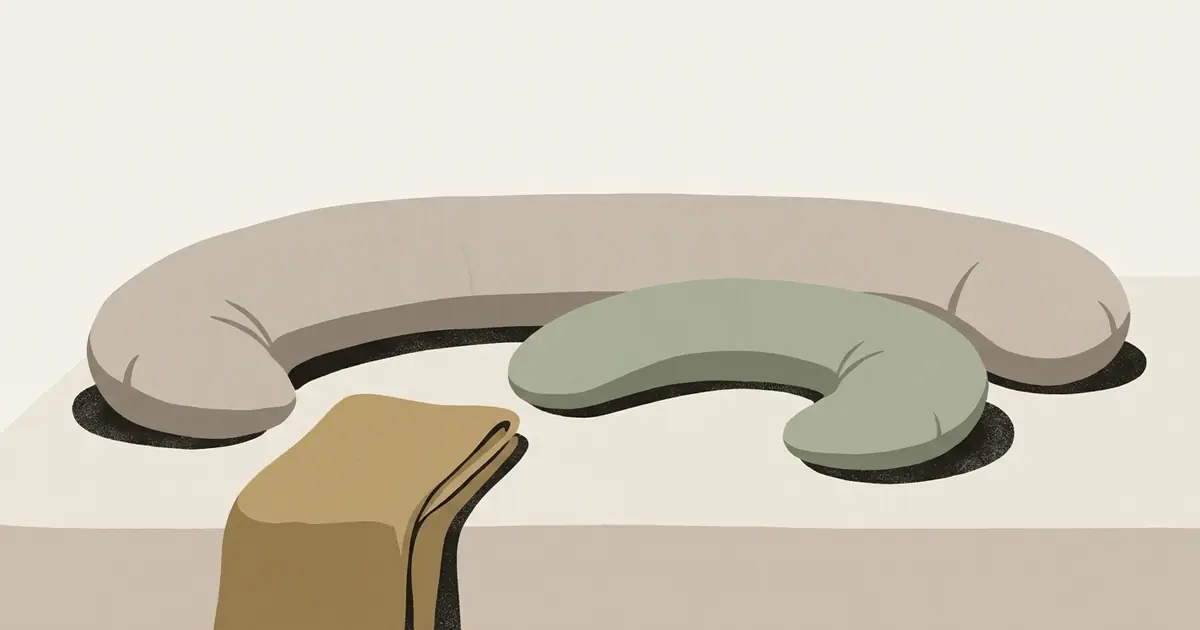 What size body pillow do I need
What size body pillow you need depends on your height and bed. A 52 inch crescent suits most adults from 5 ft to 6 ft 4 in; 36 inches suits smaller frames.
 Memory foam vs polyester body pillows
: support, weight, warmth, washing and lifespan compared, with the 1 to 2 years the Sleep Foundation gives a pillow.

