
Why your shoulder hurts when you sleep on your side
Why your shoulder hurts on your side and the pillow changes that help: lower arm position, head pillow height and 3 setups.
By Cove editorial team · Updated October 26, 2026 · 5 min read · Editorial standards

Key takeaways
- The lower shoulder is squeezed by your body weight; the top shoulder is pulled forward by the hanging arm.
- Bring the lower shoulder slightly forward so you rest on the shoulder blade, not its point.
- A head pillow that is too low adds weight to the lower shoulder.
- Rest the top arm on a pillow at chest height.
- The NHS suggests seeing a GP if shoulder pain has not improved after 2 weeks.
Your shoulder hurts on your side for one of two reasons. The lower shoulder carries much of your upper body weight, and the top shoulder is pulled forward by an arm with nowhere to rest. Bringing the lower shoulder slightly forward, using a head pillow of the right height and hugging a pillow for the top arm often helps.
Two shoulders, two problems
When you lie on your side, the lower shoulder is pressed between your ribcage and the mattress. If you lie straight on the point of the shoulder, the joint is squeezed for hours. If your head pillow is too low, your head tips down and adds more load to that same shoulder.
The top shoulder has the opposite problem. Your top arm hangs forward across your body, pulling the shoulder blade around and stretching the back of the shoulder while folding the front. By morning that can feel like an ache at the front of the shoulder or across the upper back.
Most people with side sleeping shoulder pain have one of these, and some have both. The setups below deal with each.
Fix the lower shoulder
1. Lie on your side, then reach your lower arm forward and pull the shoulder blade slightly out from under you. You should feel your weight move onto the flat of the shoulder blade, not the bony point. 2. Keep the lower arm in front of you, bent at the elbow, not under your pillow or head. 3. Check your head pillow. It should fill the gap between your neck and the outside of your shoulder, which is how the Sleep Foundation suggests choosing loft for side sleeping2.
A slightly softer mattress top can help the shoulder sink. On a very firm surface the shoulder cannot sink and takes more pressure.
Fix the top shoulder
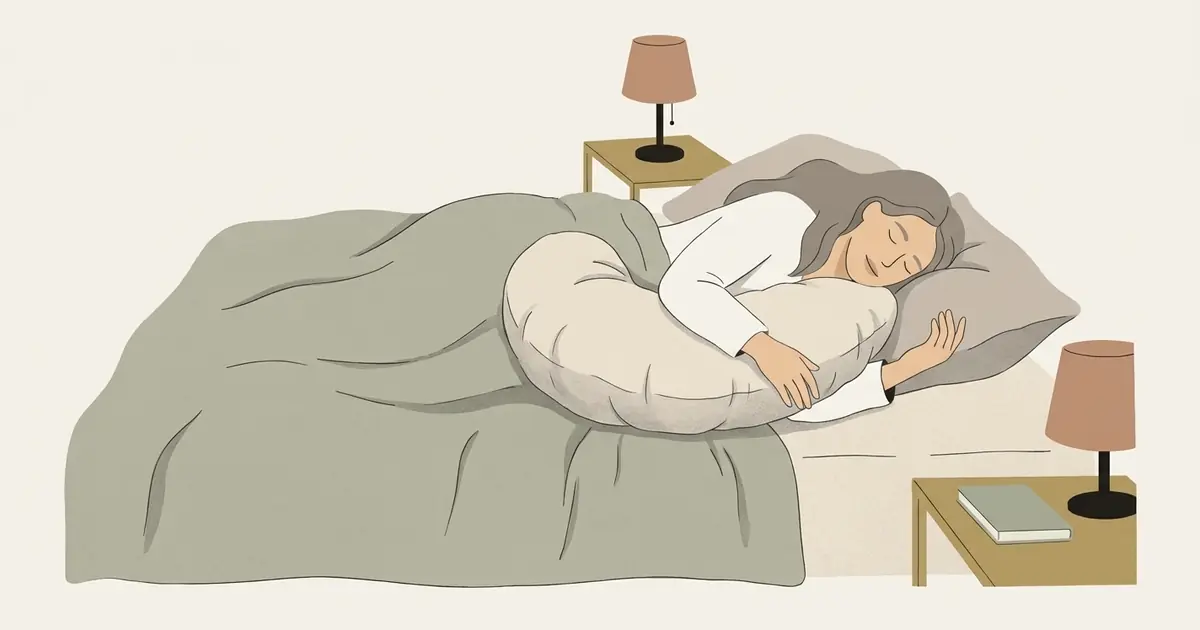
Give the top arm somewhere to rest at about chest height. A pillow hugged in front of you holds the arm level, which keeps the shoulder blade back and the shoulder joint in a neutral position. Without it, the arm hangs and the shoulder rolls forward.
The pillow needs to be thick enough that your top elbow sits roughly level with your shoulder. A thin pillow lets the arm keep dropping. A long body pillow can do this and support your knees at the same time.
Three setups to try
| Setup | What you need | Helps with | Watch for |
|---|---|---|---|
| Arm hug | One firm pillow to hug | Top shoulder rolling forward | Pillow sliding away |
| Shoulder forward | Correct head pillow height | Lower shoulder squeezed | Head pillow too low |
| Full support | A body pillow, chest to knees | Both shoulders and the hips | Takes some bed space |
Try one setup for 3 or 4 nights before changing. If you only change the head pillow, you will know whether that was the cause.
Pillow height and your neck
Shoulder and neck pain often travel together. If you wake with pain running from the side of the neck into the top of the shoulder, look at head pillow height first. Lie on your side and take a photo from behind: your nose should line up with the middle of your chest, not point down at the mattress or up toward the ceiling.
Broad shoulders need a higher pillow than narrow shoulders. If your partner uses a lower pillow comfortably, that does not mean it is right for you.
Which side to sleep on
If one shoulder hurts, lie on the other side where you can, with the sore arm resting on a pillow in front of you. That way the sore shoulder is on top and supported. The Sleep Foundation notes that side sleeping can be a better choice for some people with specific health concerns, including shoulder pain3.
If you keep rolling onto the sore shoulder during the night, a pillow behind your back makes that roll harder. More on choosing a side is in left side vs right side: does it matter.
What helps during the day
The NHS suggests several self-care steps for shoulder pain, including staying active and gently moving the shoulder, and using heat or cold packs and pain relief so you can keep moving1. It suggests a hot water bottle or a pack of frozen peas wrapped in a tea towel, each for up to 20 minutes at a time1.
The NHS also says these steps usually need about 2 weeks before shoulder pain starts to ease, and that it can take 6 months or longer to recover fully1. Patience with one setup matters.
When to see a GP
The NHS suggests getting medical help if shoulder pain does not start feeling better after 2 weeks1. Get urgent help for sudden, severe pain, pain after a fall or injury, a shoulder that looks out of shape, or if you cannot move the arm. Shoulder pain that comes with chest pain or breathlessness needs emergency care.
A physiotherapist can suggest exercises for the specific cause. General back advice from the NHS, such as staying active rather than resting in bed for long periods, applies to the upper back as well4.
Building the full side sleeping setup
Shoulder support is one part of a good side position. Knee support matters too, because a dropped top knee twists the trunk and can pull on the shoulder. See how to sleep on your side without hip pain and the complete guide to sleeping on your side.
A crescent body pillow gives the top arm a resting place and the knees support in one piece. The Cove Pregnancy Pillow is 52 inches tip to tip, with a shredded memory foam fill you can adjust through an inner zip, so the chest section can be made thicker for broad shoulders. It comes with a 100 night trial.
A simple test tonight
Before buying anything, roll a bath towel into a firm log and hug it at chest height. If your top shoulder feels better the next morning, arm support is the fix. If your lower shoulder still aches, work on head pillow height and bringing that shoulder forward.
Keep reading
From Cove

Questions
Most people find it easier to sleep on the other side, with the sore arm resting on a pillow in front of them. If you must lie on the sore side, bring that shoulder forward slightly so it is not under your full weight.
The NHS says you usually need to follow self-care steps for about 2 weeks before shoulder pain starts to ease, and that recovery can take 6 months or longer.
A head pillow that is too low lets your head drop and pushes more weight onto the lower shoulder. One that is too high bends the neck. Both are common causes of morning shoulder and neck ache.
The NHS suggests either a pack of frozen peas or a hot water bottle wrapped in a tea towel, each for up to 20 minutes at a time. Do not fall asleep with either against your skin.
Waking with a numb hand is often from lying on the arm or tucking it under the pillow. If numbness lasts after you move, or comes with weakness, speak to a GP.
Sources
- Shoulder pain, NHS. Accessed October 26, 2026.
- What is the best sleeping position?, Sleep Foundation. Accessed October 26, 2026.
- Side sleeping, Sleep Foundation. Accessed October 26, 2026.
- Back pain, NHS. Accessed October 26, 2026.
About the author
The Cove editorial team is the group at Cove that writes our guides. We write them from published guidance and our own product testing, and link every source. About the team
Related guides
 The complete guide to sleeping on your side
How to sleep on your side: line up your head, shoulders and hips, choose the right pillow height, and support your knees and back. Five fixes in 3 minutes.
 How to sleep on your side without hip pain
Side sleeping hip pain often starts with the top knee dropping. A pillow between the knees eases hip pressure. Four setup steps and a 100 night trial.

