
Using a body pillow with an adjustable bed: what to check
Use these 5 steps to check whether your body pillow works safely with your adjustable base, covering clearances, controls, and mattress instructions.
By Cove editorial team · Updated October 27, 2026 · 6 min read · Editorial standards

Key takeaways
- Always read your adjustable base and mattress manufacturer's instructions before placing any pillow on the bed.
- Check the full footprint of your body pillow with the base completely flat before raising any section.
- Keep remote controls, cables, and moving mechanisms clear of the pillow at all times.
- Reassess your pillow position every time you change the bed angle, because even a small raise shifts where the pillow sits.
- A body pillow is a comfort aid, not a substitute for positioning equipment prescribed by a clinician.
A body pillow can work well on an adjustable bed, but compatibility depends on your base model, mattress, and pillow size. The moving sections, hinges, side rails, and remote controls all create variables a flat bed does not have. Running a short compatibility check before your first night, and again after any position change, takes only a few minutes.
Start with the bed and mattress manufacturer's instructions
Your adjustable base and mattress each come with a manual, and those documents are the first place to look. Some bases specify that loose accessories should not be on the mattress while sections are in motion. Others identify a safe zone on the surface—usually the central flat portion—where soft items can rest without reaching hinges or drive mechanisms.
If your mattress is made from a flexible foam or a hybrid designed to flex with the base, the manufacturer may also note that items placed across a fold point can affect the mattress over time. A crescent body pillow is soft and flexible, so it is unlikely to cause mechanical damage, but it is worth confirming before you assume it is fine.
Once you have read both manuals, note any restrictions and keep the documents somewhere accessible. Adjustable bases vary considerably between brands and models, and general advice cannot substitute for the instructions written for your specific equipment. If the manual is unclear on any point, call or email the manufacturer before proceeding.
It is also worth checking whether your mattress warranty has any conditions about accessory use. Some manufacturers void coverage if soft items are regularly positioned across articulation zones. A quick read of the warranty section takes less time than disputing a claim later.
Check the pillow footprint with the base flat
Before you raise any section, lower the base completely flat and place the body pillow in the position you plan to sleep in. Then work through this checklist:
- [ ] The pillow lies fully on the mattress surface and does not hang over any side rail or edge
- [ ] No part of the pillow sits across or directly above a visible hinge line or fold point
- [ ] The pillow does not cover or press against any motor housing, cable, or underside mechanism accessible from the top of the bed
- [ ] The remote control or wireless receiver is on the nightstand or clipped to the side rail—not under or behind the pillow
- [ ] You can reach the controls comfortably without moving the pillow
- [ ] The pillow length suits the usable mattress area (the Cove Classic measures about 52 in [132 cm] along the curve, so check that the mattress length—minus any zones the manufacturer reserves near foot or head mechanisms—still accommodates it)
- [ ] If you have a split-king or split-queen base, the pillow sits entirely on one half rather than bridging the gap between independently moving sections
If anything on the list is not clear from the manual alone, contact your base manufacturer before continuing.
Keep moving parts and controls clear
This step matters most while the bed is actually moving. Even a pillow that is well-positioned on a flat surface can shift into a problem area as a section rises.
A few practical habits help:
**Move the pillow before adjusting.** Shift it toward the center of the bed or set it aside entirely before you raise or lower a section. Reposition it once the base has stopped and settled.
**Never let the pillow drape over the side rail.** Side rails on adjustable bases often move or retract slightly as the frame articulates. A pillow caught between the rail and the mattress edge can be pinched, and repeated pinching can stress the cover seams over time.
**Keep cords and remote controls off the mattress surface.** Corded remotes that get buried under a pillow are easy to press accidentally. A pillow resting on the control can trigger a section to move while you are trying to sleep.
**Check the split-base gap if relevant.** On split-king or split-queen setups the two halves move independently. If you use a single body pillow that spans both halves, it can bridge the gap and resist the movement of one side. On those setups, keeping the pillow on one half only is the safer approach.
**Develop a consistent pre-sleep sequence.** A stable, predictable bedtime routine can make it easier to fall asleep 2. Adjusting the base to your preferred angle first, letting it settle fully, and then positioning the pillow means you are never rearranging things around a moving surface—and it also removes a small source of late-night frustration.
Reassess comfort after changing the bed position
Side sleeping—where a body pillow provides the most benefit for spinal alignment—depends on consistent support from hips to head 1. When the head section rises, the angle under your torso changes, and a pillow that felt right at zero degrees may prop you too high or too low at 20 or 30 degrees.
After you settle on an angle, do a quick physical check:
1. Lie down in your usual side-sleeping position. 2. Notice whether your top knee is sitting higher or lower than the hip. If it has dropped, the pillow may need to be repositioned higher between your knees. 3. Check whether your shoulder is rolling forward onto the pillow or being pushed back by it. Shoulder discomfort when side sleeping is often a sign that support height needs adjusting 3. 4. If the pillow has slid down toward the foot of the bed, reposition it and consider whether a firmer fill would stay put better at that angle. 5. If you still cannot find a comfortable arrangement at a given angle, return the base to flat and start the positioning process again.
With the Cove Classic, the inner zip lets you add or remove shredded gel memory foam fill. Dialing in a slightly firmer feel may reduce migration when the mattress surface is angled. The Cove Mini is a shorter option that may be easier to position on beds with a smaller flat zone, or when you only need knee or back support at a particular angle. For more on how different fills behave, see the body pillow buying guide.
For more on preventing the pillow from migrating during the night, see how to stop a body pillow slipping out of place.
Know when to ask the bed or pillow manufacturer
Some questions fall outside what a general guide can answer reliably. The table below outlines who to contact depending on what you need to know.
| Situation | Who to ask |
|---|---|
| Unsure whether your base restricts accessories during articulation | Adjustable base manufacturer |
| Pillow seems to be interfering with a hinge or mechanism | Adjustable base manufacturer |
| Mattress has shifted on the base after you started using a body pillow | Both mattress and base manufacturer |
| Single pillow spans a split base and you want to confirm it is safe | Adjustable base manufacturer |
| Want to confirm pillow dimensions against your mattress's flat zone | Pillow manufacturer |
| Unsure whether the cover can tolerate repeated pinching near a rail | Pillow manufacturer |
One broader point: if you have been given positioning guidance by a doctor or physiotherapist—for instance, a specific wedge or support angle to manage a circulatory, respiratory, or joint condition—follow that guidance first 1. A body pillow is a comfort accessory for side sleepers and is not designed to replicate prescribed clinical positioning equipment. If you are unsure whether a body pillow is appropriate alongside your prescribed setup, ask your clinician before making any changes.
For more on sizing a pillow to your bed and sleep style, see what size body pillow do I need.
More in this series: how to compare two body pillows at home and before buying a heavy body pillow: a handling checklist.
From Cove


Questions
Possibly, but compatibility depends on your specific base and mattress, not on the pillow alone. Start by reading your bed manufacturer's instructions to check whether they restrict accessories or soft items on the surface when sections are in motion. If there are no restrictions, do a flat-base check first: lay the pillow out, confirm it clears all hinges and side rails, and only then try raising a section. Never assume compatibility across different base brands or models.
Yes. When the head or foot section rises, the mattress surface tilts and any loose object on it—including a body pillow—will shift. A crescent-shaped pillow can slide toward the foot of the bed when the head rises, or bunch against the raised foot section. You will likely need to reposition it each time you adjust the angle. If the pillow slips repeatedly, see our guide on how to stop a body pillow slipping out of place for surface and cover options that may help.
No. A body pillow is a general comfort accessory for side sleepers. If a doctor, physiotherapist, or other clinician has prescribed specific positioning equipment or wedges to manage a health condition, that prescription takes priority. Do not substitute a body pillow for prescribed equipment without first speaking to the relevant clinician.
With the head raised, the upper part of the mattress tilts, so a full-length crescent pillow needs to be repositioned higher toward the headboard than you would place it on a flat surface. Check that the pillow still clears any side rails and that no part of it sits across or near a hinge point. Your bed's manual may indicate a zone of the mattress that is safe for loose accessories.
It can. If you use a pillow with adjustable shredded foam fill—such as the Cove Classic, which has an inner zip for adding or removing fill—you may find that a firmer fill stays in place better when the mattress angle changes. A looser, flatter fill tends to shift more freely. Adjust the fill on a flat base first, then recheck loft and position once you settle on your preferred bed angle.
Sources
- What is the best sleeping position?, Sleep Foundation. Accessed October 27, 2026.
- How to fall asleep faster and sleep better, NHS Every Mind Matters. Accessed October 27, 2026.
- Shoulder pain, NHS. Accessed October 27, 2026.
About the author
The Cove editorial team is the group at Cove that writes our guides. We write them from published guidance and our own product testing, and link every source. About the team
Related guides
 How to stop a body pillow slipping out of place
Find out why your body pillow keeps slipping and fix it with 5 steps covering placement, fabric pairing, covers, sheets, and your turning routine.
 Body pillow buying guide
How to choose a body pillow: shape first, then length, fill and cover. What each choice changes for side sleepers, and why a 100 night trial helps.
 What size body pillow do I need
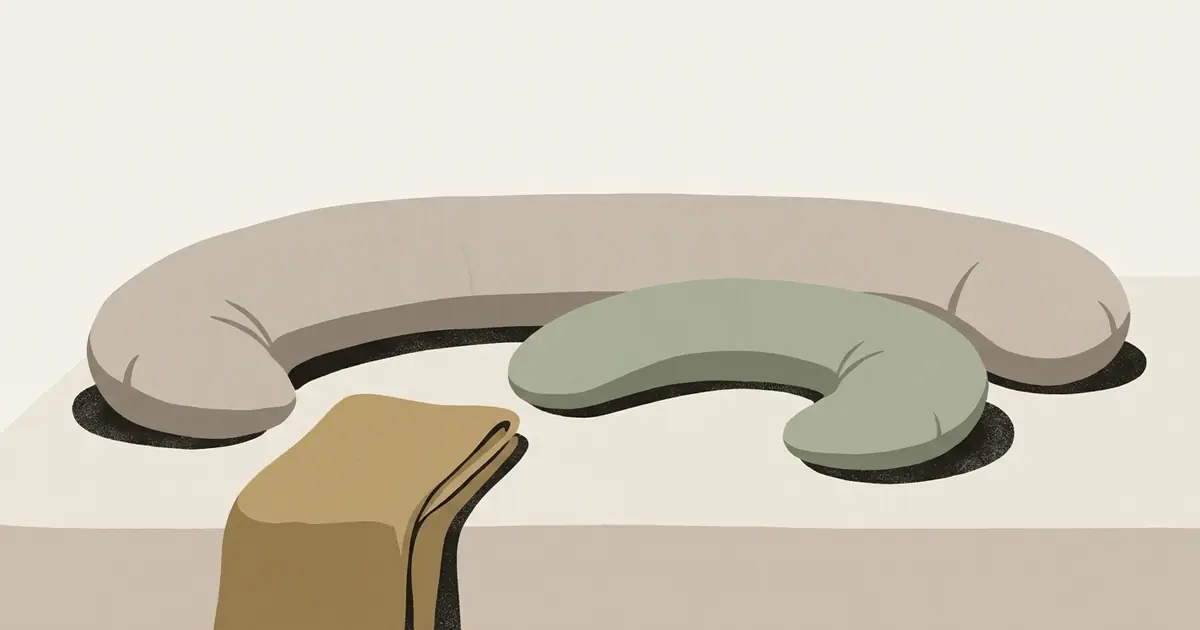
What size body pillow you need depends on your height and bed. A 52 inch crescent suits most adults from 5 ft to 6 ft 4 in; 36 inches suits smaller frames.


