
How to stop a body pillow slipping out of place
Find out why your body pillow keeps slipping and fix it with 5 steps covering placement, fabric pairing, covers, sheets, and your turning routine.
By Cove editorial team · Updated October 27, 2026 · 7 min read · Editorial standards

Key takeaways
- Movement usually comes from one of three sources: the pillow shifting on the mattress, the cover sliding on the pillow, or the sheet pulling everything along when you turn.
- Start by checking placement before changing any product, since a pillow that sits away from your body has little friction to keep it anchored.
- Slippery cover-and-sheet combinations are a common culprit; switching to a matte or textured fabric pairing can reduce drift.
- Leaving yourself enough space to turn naturally means the pillow moves with you rather than being kicked aside.
- If the pillow is regularly too large or too small for your sleeping area, a different size may simply suit your setup better.
A body pillow that keeps slipping usually comes down to one of three causes: the pillow moving against the mattress, the cover sliding on the fill inside, or your sheets pulling everything out of place when you turn. Figuring out which is happening takes only a few minutes, and most fixes cost nothing.
Find out what is moving: pillow, cover or bedding
Before changing anything, spend a moment the next morning noting where everything ended up. Did the pillow move as a single unit, or did the cover shift while the fill stayed roughly in place?
If the whole pillow migrated across the bed or ended up on the floor, the issue is friction between the pillow and the sheet beneath it. If the cover has ridden up or twisted while the fill stayed in position, you are dealing with cover-on-fill slippage — a tighter-fitting cover, or one that zips securely, reduces that specific problem. If your duvet or top sheet pulled the pillow sideways, that is a bedding-interaction problem and is worth reading about separately in How to keep your duvet from tangling around a body pillow.
Knowing which layer is moving lets you address the right thing rather than experimenting at random. It also saves you money: changing the cover when the real problem is sheet texture, for instance, may have no effect at all.
If you are not sure what to look for when you reassess in the morning, the guide on How to read the labels on a body pillow and its cover explains what the care and construction details on a cover tell you about its fabric weight and weave — both of which influence grip.
Check pillow placement before changing products
Placement is the lowest-effort variable to adjust, and it is worth ruling out before buying anything new. Side sleeping is one of the most common sleep positions,1 and a body pillow works best when it is in close contact with your body — not resting a few inches away where it has no friction from your weight to anchor it.
A few placement experiments to try:
- [ ] Start with the pillow pressed against your chest and knees rather than loosely beside you.
- [ ] Position the curve of a crescent pillow so both ends make contact — one near your chin, one tucked between your knees — creating two anchor points instead of one.
- [ ] Check that the pillow is not overhanging the edge of the mattress, which gives it a natural direction to fall.
- [ ] If you share the bed, make sure the pillow is not wedged against your partner in a way that rebounds it toward you each time they move.
- [ ] Sleep closer to the center of the mattress rather than the edge, so the pillow has room on both sides and is not being pushed off by the boundary.
These adjustments work with the way your body naturally shifts during sleep2 rather than trying to prevent movement altogether. Attempting to hold one posture all night is neither realistic nor necessarily helpful,3 so the goal is always a setup that accommodates turning, not one that resists it.
Try a different cover-and-sheet combination
Fabric pairing is a surprisingly common cause of drift. A smooth pillowcase against a smooth sheet creates very little friction — both surfaces glide freely, and the pillow moves with minimal force. The fix is to introduce texture somewhere in the pairing. You do not need to change both surfaces, just one.
| Cover texture | Sheet texture | Expected grip |
|---|---|---|
| Smooth (sateen, silk-like) | Smooth (sateen) | Low — likely to slide |
| Smooth (sateen, silk-like) | Matte or jersey | Moderate — better grip |
| Matte or textured weave | Smooth (sateen) | Moderate — better grip |
| Matte or textured weave | Matte or jersey | High — least movement |
Note that fabric behavior varies by weave density and finish — this table reflects general tendencies, not tested results for specific products. Do not assume any fabric is non-slip unless the manufacturer has labeled it as such.
The Cove Classic uses a removable zip-off cover in a Tencel lyocell blend that is machine washable, which means you can experiment with different sheet textures underneath without any permanent change. If you have a spare cover or a different set of sheets available, try the alternative pairing for a few nights before drawing conclusions. See How to put a cover on a crescent body pillow if you need help refitting the cover after washing.
The fill inside the Cove Classic is shredded gel memory foam that you can adjust through an inner zip, so if the pillow currently feels very overfilled and sits high off the mattress surface, reducing the fill slightly can lower the center of gravity and make it less prone to tipping — though this is a secondary effect rather than a direct grip solution.
Leave yourself room to turn
Trying to stay rigidly in one position throughout the night is not realistic and not what a body pillow is designed to enforce.3 Disrupted or forced sleep posture can itself affect sleep quality,3 so the aim is comfort, not immobility.
Set the pillow up so that turning naturally brings it with you rather than leaving it behind. The guide on How to turn over comfortably with a body pillow covers this in detail, but the practical steps are:
1. Keep the pillow in contact with both your upper arm and your top knee, so when your body rolls, it carries the pillow rather than pivoting around it. 2. Do not tuck the pillow under your hip — if it is pinned beneath your body, turning will always pull you away from it. 3. If you wake facing the other direction and the pillow is far behind you, bring it back to the front when you reposition. That is normal and does not mean the setup has failed. 4. If you are using a crescent pillow, note that the curve allows you to loop an arm over the top end when you turn, which keeps light contact without requiring you to grip it consciously. 5. Check that your duvet is not so heavy that it traps the pillow in place on one side — a duvet that grips the cover fabric creates resistance that can drag the pillow sideways as you turn.
If you find that shoulder discomfort is prompting you to shift position more frequently during the night, that is worth attention in its own right.4 Shoulder pain that does not ease within two weeks, or that comes with pins and needles, numbness, or restricted arm movement, warrants advice from a doctor or physiotherapist rather than a pillow adjustment.4 The guide on Why your shoulder hurts when you sleep on your side has more context on that specific pattern.
When a different size may be more practical
Sometimes slipping is less about friction or placement and more about the pillow being the wrong fit for the space available. A full-length pillow on a narrow bed, or in a situation where you sleep in a small section of a larger bed, will overhang edges or press against surfaces that push it back toward you or off the side entirely.
Consider a shorter or more compact option if:
- The pillow regularly ends up at a diagonal because it is too long to lie straight in your usual sleep zone.
- You use the pillow mainly on a couch, in a guest bed, or while traveling, where a full-length version is awkward to position and has less stable surface beneath it.
- You want a dedicated pillow for behind-the-knee or lower-back support rather than full front-of-body contact.
The Cove Mini is a smaller crescent designed for travel, the couch, or use as a knee or back pillow. It uses the same removable zip-off cover and adjustable fill approach as the full version, and packs into a suitcase. Because it occupies a smaller footprint on the mattress, there is less surface area available to drift across, which can make a practical difference in a confined sleep space.
If you are unsure whether the length difference would suit your setup, What size body pillow do I need walks through the decision based on bed size, sleeping area, and intended use. A pillow that fits your actual space requires less corrective repositioning and, in practice, moves less overnight.
More in this series: start with the body pillow buying guide and using a body pillow with an adjustable bed: what to check.
From Cove


Questions
This usually happens when you turn over during the night and push the pillow away rather than rolling with it. A pillow that is too large for the space between you and the edge of the bed has nowhere to go except off the side. Try starting the night closer to the center of the mattress, and position the pillow so it hugs your front rather than sitting loosely beside you. A cover with a slightly textured surface will also grip the sheet better and reduce how far the pillow travels during each turn.
Strapping a pillow to yourself is not practical or comfortable, and restraints around the body can limit the natural movement your body needs during sleep. The goal is to make the pillow easy to move with, not to lock it in place. Focus instead on placement, cover texture, and giving yourself room to turn — adjustments that work with your movement rather than against it.
Yes. A very smooth cover fabric — such as a tightly woven sateen — creates less friction against similarly smooth sheets, so the pillow slides more readily. Pairing a smooth cover with a matte or jersey sheet, or vice versa, introduces enough grip to reduce drift. If you recently changed either your pillow cover or your bedding and the slipping worsened, the new pairing is a likely cause.
Adjusting the fill changes the pillow's firmness and loft rather than its grip on the mattress, so it has limited direct effect on slipping. That said, a very overfilled pillow sits higher and is easier to knock out of position, while a very underfilled one compresses flat and offers less resistance to movement. A fill level that keeps the pillow gently supportive without being rigid gives it a stable, consistent shape to rest in.
Yes. A pillow that is too long for your bed or too wide for the space you sleep in will overhang edges or press against walls, creating leverage that makes it easier to dislodge. A pillow that is too small may not stay in contact with your body as you shift. Matching the pillow length to your sleeping area — and choosing a full-length or compact version based on your actual space — reduces unnecessary movement.
Sources
- What is the best sleeping position?, Sleep Foundation. Accessed October 27, 2026.
- Side sleeping, Sleep Foundation. Accessed October 27, 2026.
- Insomnia, NHS. Accessed October 27, 2026.
- Shoulder pain, NHS. Accessed October 27, 2026.
About the author
The Cove editorial team is the group at Cove that writes our guides. We write them from published guidance and our own product testing, and link every source. About the team
Related guides
 How to turn over comfortably with a body pillow
Change sides in bed without fighting your body pillow: 3 options for moving it, leaving it in place, or resetting it, plus duvet and shared-bed tips.
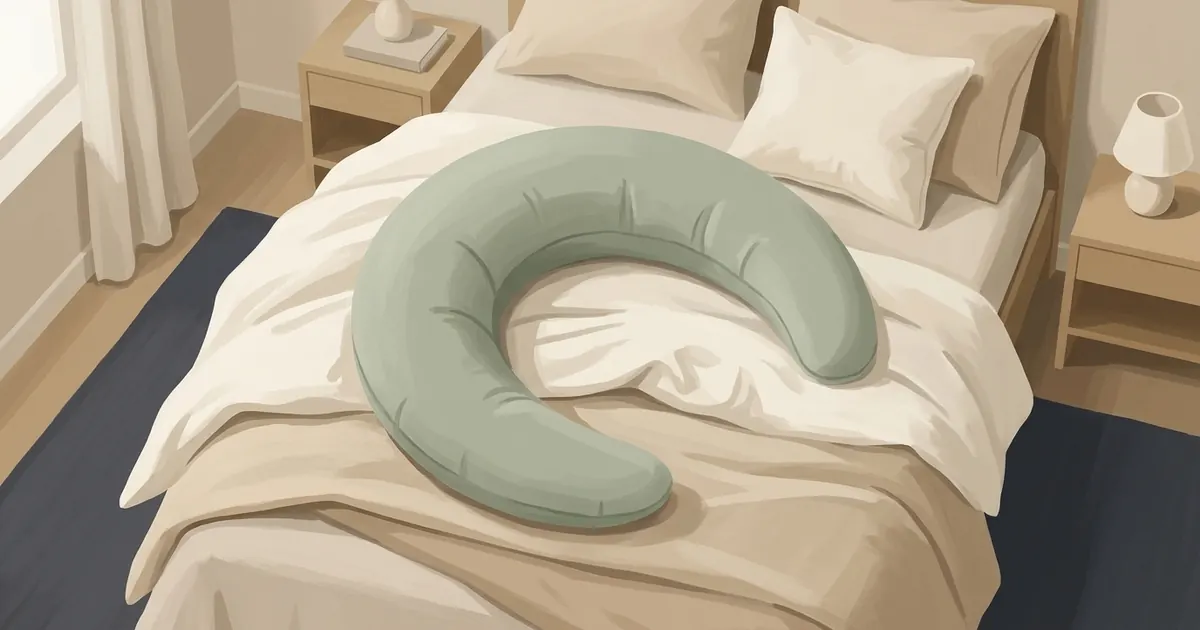 How to keep your duvet from tangling around a body pillow
Duvet tangling around your body pillow? Fix it in 5 steps: find where it catches, layer above or below, leave slack for turning, and check the cover fit.
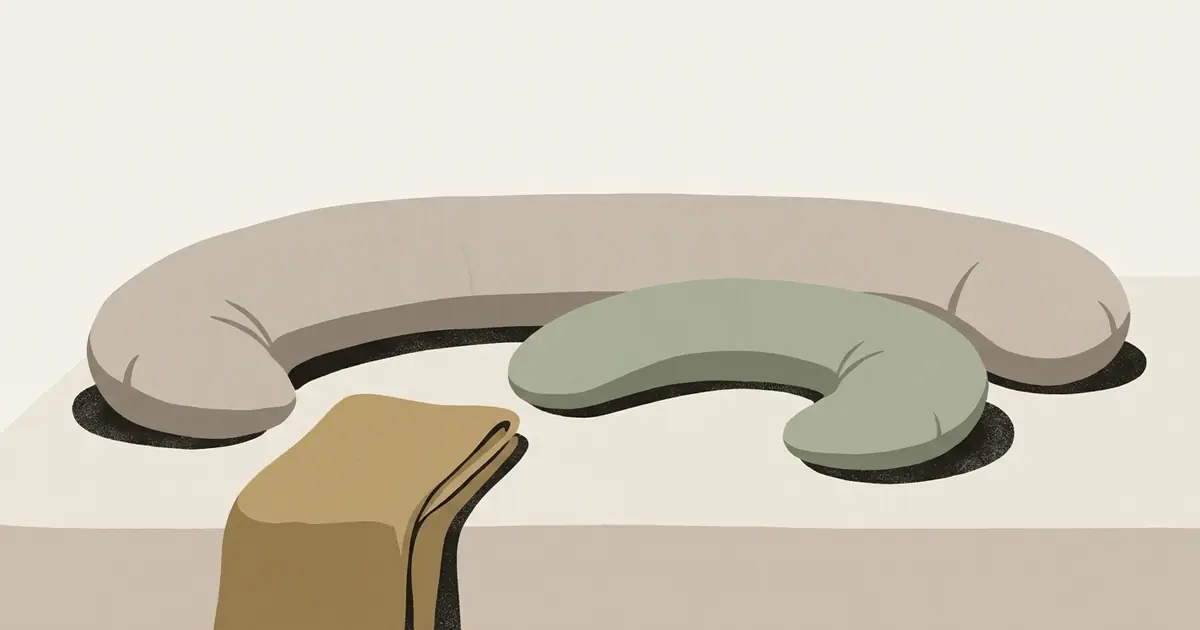 What size body pillow do I need
What size body pillow you need depends on your height and bed. A 52 inch crescent suits most adults from 5 ft to 6 ft 4 in; 36 inches suits smaller frames.


