
How to turn over comfortably with a body pillow
Change sides in bed without fighting your body pillow: 3 options for moving it, leaving it in place, or resetting it, plus duvet and shared-bed tips.
By Cove editorial team · Updated October 27, 2026 · 6 min read · Editorial standards

Key takeaways
- You do not have to move the pillow every time you turn—leaving it in place and reaching for it after you roll is often easier.
- A crescent pillow follows a short, predictable arc when you flip it, which makes it faster to reposition than a straight full-length pillow.
- Keeping your duvet loosely laid rather than tightly tucked reduces the chance of it tangling during a turn.
- In a shared bed, agreeing on a consistent pillow placement means your partner is less likely to encounter it mid-night.
- If you turn over frequently, a shorter or lighter pillow may suit you better than a full-length one.
Turning over with a body pillow comes down to method. Decide in advance whether to bring the pillow with you as you roll or leave it in place and pull it toward you once you have settled on the other side. A crescent shape makes either approach easier because the curve gives you a natural grip point.
Give yourself enough space to move
Before anything else, check where you are lying. If you are close to the edge of the mattress, shifting a body pillow is harder and slightly risky. Aim to be in the center of the bed, or at least far enough from the edge that you can roll without pulling the pillow off with you.
A wider mattress helps, but even on a standard queen you can usually manage a body pillow comfortably if you are deliberate about your starting position. If you find yourself consistently drifting toward one side during the night, a pillow that tends to migrate may be part of the problem—how to stop a body pillow slipping out of place covers that separately.
Also check your fill level before you work on technique. If your pillow is packed too firmly it will resist reshaping as you move; if it is too loose it may fold awkwardly mid-turn. The Cove Classic has an inner zip so you can remove a handful of shredded foam to find the weight that suits you best.
Finally, think about your head pillow and neck position. Side sleeping generally calls for enough loft under your head to keep your neck level with your spine2, so it is worth getting that sorted before you focus on the body pillow turn. Once your head is supported consistently, the rest of the movement tends to feel more controlled.
Three ways to change sides with a pillow
There is no single correct method. Try each one over a few nights and notice which disrupts your sleep the least.
**1. Leave it and reach back** Roll away from the pillow first, complete the turn, then pull the pillow in close behind or in front of you depending on which side you now want it on. This is the lowest-effort approach and works well when you are not fully awake during the turn. The pillow stays roughly in place while you do the moving.
**2. Carry it with you** Hug the pillow loosely before you start the roll and let it rotate with your body. With a crescent shape, grip one curved end and the mid-section. The pillow will swing in an arc and land roughly where you need it. This takes a little practice but means the pillow is already in position when you finish the roll, with no reaching required afterward.
**3. Flip it over the top** If you sleep with the pillow running lengthwise between your knees and torso, you can push it up and over your hip as you roll so it ends up on the other side without you lifting it fully. This suits lighter or shorter pillows particularly well and requires the least upper-body effort of the three methods.
Use the checklist below to try each method systematically over a few nights:
- [ ] Night 1–2: Try the leave-and-reach method and note whether you wake fully during the turn
- [ ] Night 3–4: Try the carry method and check whether the pillow lands in a useful position
- [ ] Night 5–6: If you use a knee-support position, try the flip-over-the-top method
- [ ] After one week: Stick with whichever approach caused the least disruption
- [ ] Optional: Adjust fill firmness if the pillow feels too rigid or too floppy during the turn
Keep the duvet from tangling
A body pillow and a tightly tucked duvet do not work well together. The pillow catches the duvet and pulls it with you when you turn, which wakes you up and can disturb a partner too.
The simplest fix is to avoid tucking the duvet under the mattress at the sides. A loosely laid duvet moves with you rather than fighting you. If you use a heavy duvet, consider a lighter one for warmer months so there is less mass to drag through the turn.
You can also try keeping the duvet on top of the pillow rather than folded tightly around it. That way, the pillow moves freely underneath while the duvet stays in roughly the same position. It also makes it easier to toss the duvet aside briefly if you need to reposition the pillow with both hands before pulling the covers back over.
If you find the cover on your pillow bunches or grabs at the sheet during a turn, it may be worth checking whether the cover fits correctly. A cover that is slightly too large will shift around and add friction. How to choose a cover that actually fits your body pillow explains what to look for.
Make a shared-bed setup easier
A body pillow in a shared bed can feel like an uninvited barrier if there is no clear system. A few small agreements make a real difference.
| Situation | Practical approach |
|---|---|
| One partner uses a body pillow, one does not | Keep the body pillow on the outer side of the user, away from the center of the bed |
| Both partners use body pillows | Each person keeps their pillow on their own outer side; the center stays clear |
| Frequent turner disturbs partner | Use the leave-and-reach method so overall movement is minimal |
| Body pillow keeps crossing to partner's side | Check fill level; a slightly firmer pillow holds its shape and is less likely to migrate |
If one of you finds a full-length body pillow takes up too much space, the Cove Mini is worth considering. It covers the hip and knee area without extending the full length of the bed, which makes turning easier and reclaims space in the center. Because it is shorter and lighter, the carry method in particular becomes much less effort.
For more on how shared or solo side-sleeping setups vary, the complete guide to sleeping on your side covers the fundamentals in one place.
When a shorter or lighter pillow may suit you
A full-length body pillow suits people who stay on one side for long stretches. If you turn four or five times a night, the effort of repositioning a 52 in [132 cm] pillow each time adds up and can fragment your sleep3.
Signs that a shorter pillow may work better for you:
- You feel the pillow drag against the sheet every time you turn
- You often wake to find it across your partner's side of the bed
- You use it mainly for knee or hip support rather than full-torso contact
- You want to take a pillow when you travel without checking luggage
The Cove Pregnancy Pillow Mini addresses all of these. It packs into a suitcase and works as a knee pillow, a lower-back support, or a compact side-sleeping aid. It uses the same cover and adjustable shredded fill approach as the Classic, so you are not giving up adjustability, just length.
For a fuller comparison of sizes before you decide, what size body pillow do I need walks through the trade-offs in detail. If hip discomfort is part of why you are turning frequently, how to sleep on your side without hip pain may also be useful to read alongside this guide.
If shoulder discomfort is what wakes you and prompts the turn, pain that does not start to improve after two weeks is worth discussing with a doctor or physiotherapist1 rather than managing through pillow adjustments alone.
More in this series: start with the body pillow buying guide, using a body pillow with an adjustable bed: what to check and how to compare two body pillows at home.
From Cove


Questions
No. Many people find it easier to leave the pillow in place and roll away from it, then pull it close again once they have settled on the other side. Moving it every time is only necessary if you want support on both sides simultaneously from the start of each new position.
Yes, though frequent turners tend to do better with a shorter or lighter pillow that moves quickly. A crescent-shaped pillow like the Cove Classic is easier to flip than a straight full-length pillow because its curved ends naturally guide the arc of the rotation. If repositioning still feels disruptive, a smaller option such as the Cove Mini may suit your sleep style better.
Not for most people. A second pillow means you never have to move anything—one stays on each side—but it takes up considerable bed space and can make a shared bed feel crowded. It is worth trying a single pillow with the leave-and-reach method described in this guide before deciding you need two.
Discomfort during a turn can sometimes come from your position on the mattress rather than the pillow itself. Make sure you have enough space in the center of the bed before you move. If shoulder or hip pain persists beyond a couple of weeks regardless of how you turn, it is worth speaking with a doctor or physiotherapist rather than adjusting pillow position alone.[^1]
Sources
- Shoulder pain, NHS. Accessed October 27, 2026.
- What is the best sleeping position?, Sleep Foundation. Accessed October 27, 2026.
- Insomnia, NHS. Accessed October 27, 2026.
About the author
The Cove editorial team is the group at Cove that writes our guides. We write them from published guidance and our own product testing, and link every source. About the team
Related guides
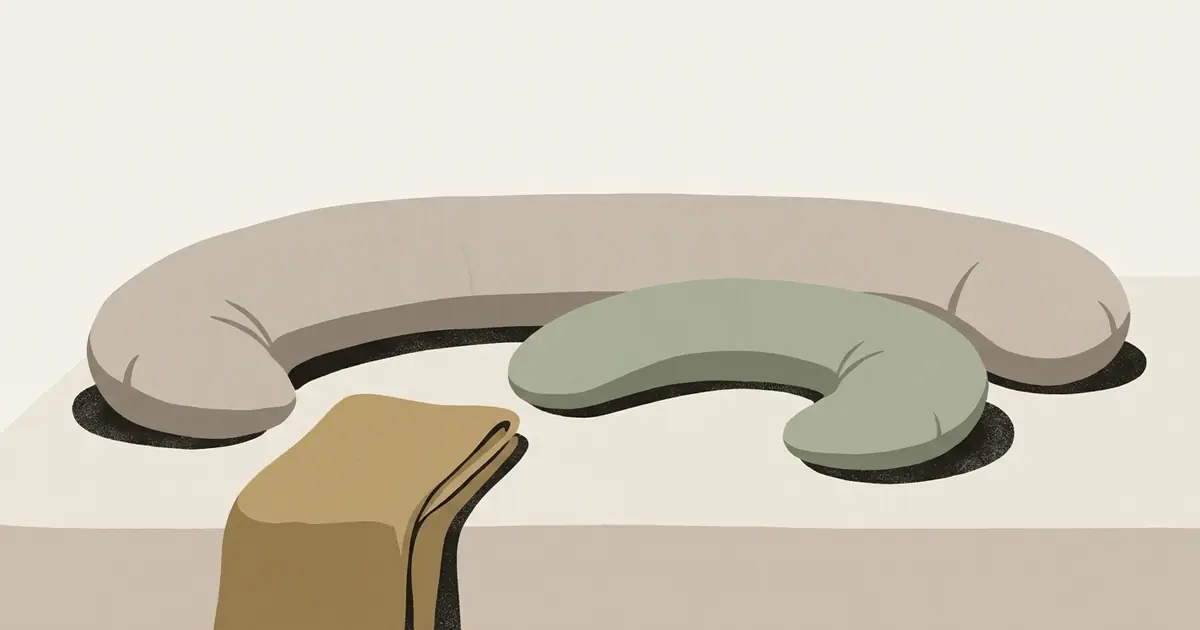 What size body pillow do I need
What size body pillow you need depends on your height and bed. A 52 inch crescent suits most adults from 5 ft to 6 ft 4 in; 36 inches suits smaller frames.
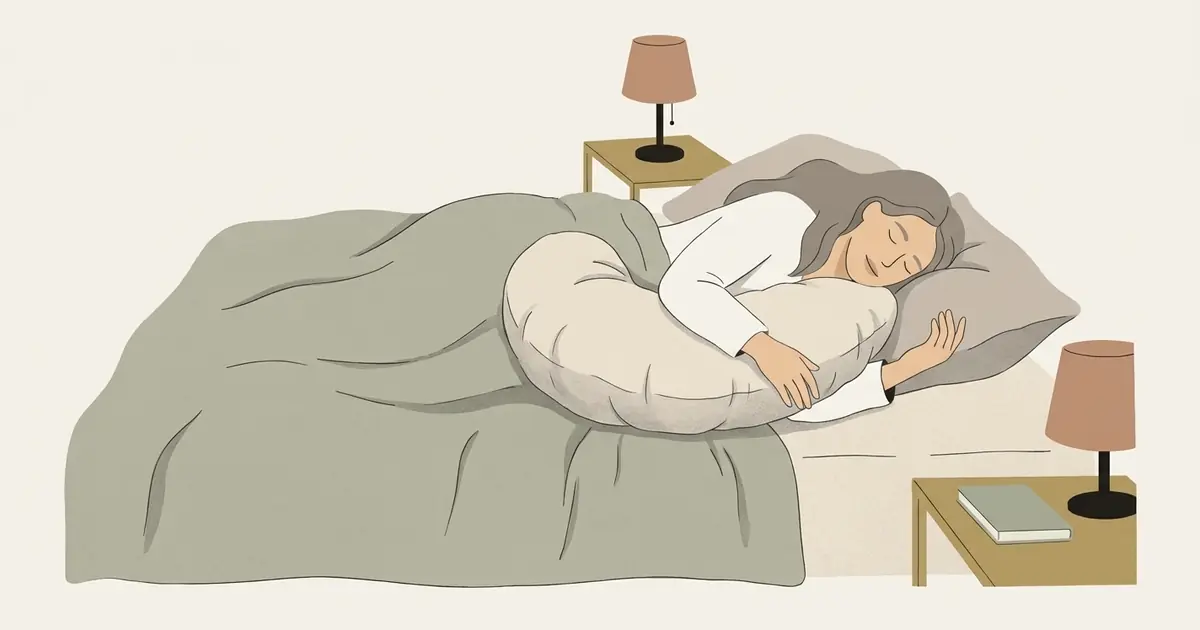 The complete guide to sleeping on your side
How to sleep on your side: line up your head, shoulders and hips, choose the right pillow height, and support your knees and back. Five fixes in 3 minutes.
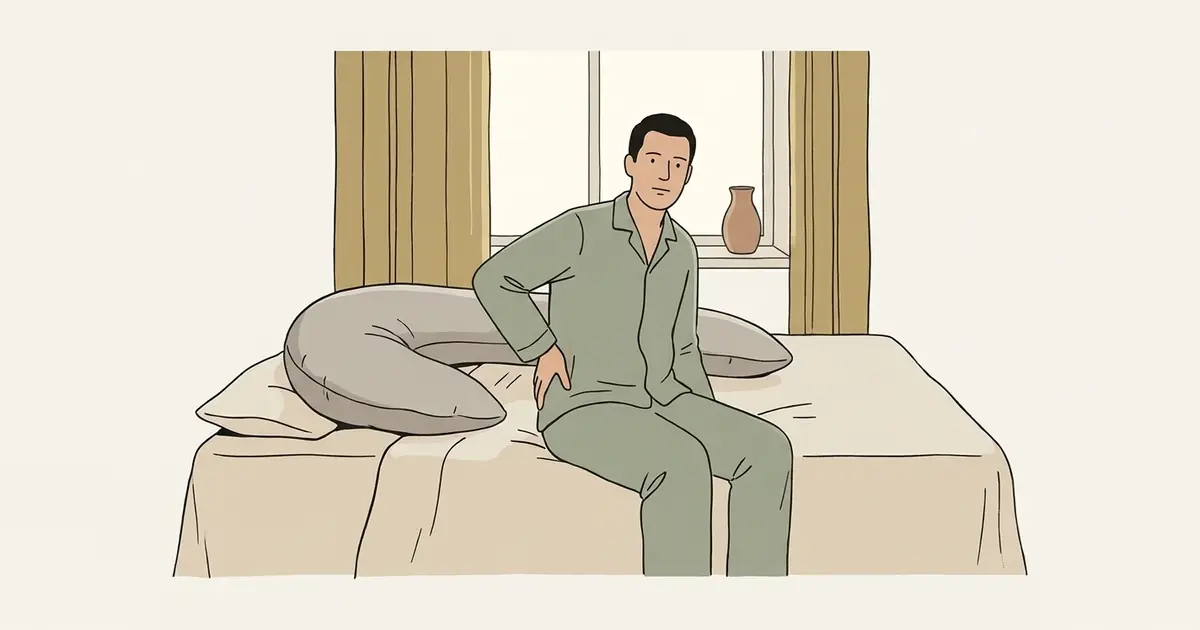 How to sleep on your side without hip pain
Side sleeping hip pain often starts with the top knee dropping. A pillow between the knees eases hip pressure. Four setup steps and a 100 night trial.


