
Recreating your body-pillow setup in a hotel
Spend 2 minutes on arrival checking your hotel bed and you will know exactly which pillows to use for a comfortable night without your body pillow.
By Cove editorial team · Updated October 27, 2026 · 7 min read · Editorial standards

Key takeaways
- Check mattress firmness and count the pillows available before you unpack anything.
- Start with a head pillow that keeps your neck in line with your spine, then add support for your knees and back.
- You rarely need to recreate your entire home setup — focus on the one or two points of support you notice most.
- Hotels can often provide extra pillows on request, though availability is not guaranteed.
- Keep your arrangement simple enough to undo in a few minutes before checkout.
Getting a decent night's sleep in a hotel when you rely on a body pillow at home comes down to two things: reading the bed you have and deciding which parts of your usual setup matter most. You rarely need to rebuild everything — focus on the one or two contact points that make the biggest difference.
Check the mattress and available pillows on arrival
Before you unpack, sit on the edge of the bed and press down with your hand. A much softer or firmer surface than the one you sleep on at home will change how your hips and shoulders sit, which in turn changes the height you need from any pillow you use. Note whether the mattress lets you sink in significantly or holds you up close to the surface. These are the two basic conditions you are designing around, and recognizing them early saves you from chasing comfort at midnight when you are already tired.
Next, count the pillows. Most hotels put two or four standard pillows on the bed. Take one off the stack and hold it upright — if it collapses immediately it is soft-fill; if it stays roughly square it has more structure. Knowing the fill type tells you how many you might need to layer or fold to get useful support at a specific point, such as behind your knees or tucked along your lower back.
Also scan the room for a spare blanket or throw. A tightly rolled blanket can stand in for a body pillow in a pinch — it will not contour the way a shaped pillow does, but it provides a surface to rest an arm on or a light prop behind your back. Noting what is available before you need it means you are not hunting around in the dark later.
Side sleeping is the most common position among adults, and it tends to work best when your spine stays aligned from your neck through your hips 1. Getting the surface assessment out of the way first gives you a clear picture of what kind of support you actually need to add before you start stacking pillows. The complete guide to sleeping on your side covers alignment in more detail if you want a fuller reference.
Start with the head pillow you will actually use
Your head pillow sets the baseline for everything else. If it is too flat, fold a spare pillow in half and slide it underneath to raise the height. If it is too tall — common in hotels that use thick, overstuffed pillows — remove a layer or swap to a single softer one. The goal is a neutral spine from your neck down through your hips, a position that research associates with pain relief and better overall spinal support 2.
Once the head pillow height feels right, lie in your usual side-sleeping position for a quiet minute before adding anything else. You may find the mattress compensates for some of what your body pillow normally does at home, or you may feel straight away where the gaps are. A firmer mattress pushes back against your hip and shoulder and may reduce the gap that a body pillow normally fills between the knees. A softer mattress lets you sink more, which can increase shoulder pressure and make back-of-hip support feel more important.
Taking that quiet minute before piling on extra pillows is worth doing. It prevents you from solving a problem you do not actually have in this particular bed, and it gives you clearer information about what to add next. If you brought your Cove Mini from home, place it now. Its crescent shape works as a knee pillow, a back prop, or a light hug surface — the same roles it fills at home, just adapted to a different sleeping surface.
Recreate only the support you miss
Most people who rely on a body pillow use it for two or three specific things: something between the knees to reduce hip strain, something behind the back to prevent rolling, and sometimes something to hug or rest an arm on. You do not need to replicate all of these with hotel pillows — only the ones you would actually notice without.
Work through this checklist before you settle in for the night:
- [ ] Knees: is there a noticeable gap between them when you lie on your side? If yes, fold a spare pillow and place it between your knees.
- [ ] Lower back: do you tend to roll onto your back during the night? If yes, push a spare pillow firmly against your back as a light stop.
- [ ] Arm and shoulder: does your top shoulder tend to roll forward? If yes, hug a spare pillow at roughly chest height.
- [ ] Hip pressure: does the mattress feel uncomfortably firm at the hip? If yes, ask housekeeping whether a mattress topper or extra blanket is available to layer beneath you.
- [ ] Room temperature: is the room warm or stuffy? Most people sleep best somewhere around 65–68 °F (18–20 °C) 3. Adjust the thermostat before you settle in — it is one of the simplest changes available to you and costs nothing.
For more on the knee-pillow question specifically, the guide on whether you should sleep with a pillow between your knees covers the reasoning behind that position in more detail.
If you are working with only two pillows and need both for your head and your knees, a tightly rolled towel from the bathroom can function as a temporary knee prop for a night or two. It is firmer than a pillow but workable, and it frees up the second pillow for behind your back if that is where you feel unsupported most.
Ask the hotel about spare pillows if needed
If the bed comes with only two pillows and you need more to fill the gaps you identified above, call housekeeping or ask at the front desk. Many hotels keep a linen store and will bring extra pillows on request, though this varies by property and time of night. Asking at check-in is more reliable than asking at midnight.
When you make the request, being specific helps. Ask for one or two extra standard bed pillows rather than making a vague request for more bedding. Body pillows are not a standard hotel item, so framing your request around the pillows already on the bed is more likely to get a clear and quick response. If extra pillows are not available, ask whether a rolled blanket or spare comforter can be sent up instead.
Consistency in small habits around sleep — including simple routines like setting up your sleeping arrangement deliberately before lying down — can support more restful nights even in unfamiliar settings 4. Running through a short setup process each evening is a low-effort way to make an unknown room feel more controlled and less random. Familiar cues, even minor ones, can ease the transition that comes with sleeping somewhere new.
If you have brought your Cove Classic from home, you are already in a good position. It runs about 52 in (132 cm) along the curve and fills the same functional roles it does in your own bed, regardless of the mattress beneath it. A familiar pillow is one of the more reliable ways to carry a consistent sleep habit from home to hotel.
Keep the setup easy to undo before checkout
Hotel stays often end with an early alarm and not much time to spare. If your sleeping arrangement involves several pillows repositioned in a complex pattern, reassembling the bed to its original state before you leave becomes a small but real inconvenience. A few principles keep things manageable from the start.
| Arrangement | Easy to undo? | Notes |
|---|---|---|
| One extra pillow between knees | Yes | Place it back on the bed before leaving |
| One pillow pushed behind back | Yes | Remove and straighten the covers |
| Spare pillow added under existing stack | Yes | Pull it out and restack in the original order |
| Your own cover on your travel pillow | Yes | Swap back before packing |
| Pillow inserted inside the hotel duvet cover | No | Avoid this approach entirely |
Leaving the bed roughly as you found it — sheets straightened, pillows back in their original arrangement — takes about two minutes if you kept the setup simple. That ease of reversal is worth factoring in when you decide how elaborate to make things on the first night.
If you find yourself consistently unhappy with hotel pillow arrangements across multiple trips, it is a reasonable signal that a dedicated travel pillow is worth adding to your kit. The Cove Mini is designed to pack into a suitcase and handles the knee, back, and arm-rest roles that standard hotel pillows approximate only loosely. For the full picture on getting a pillow from home to destination without damage, the guide on how to pack a body pillow for a trip covers the practical logistics in detail.
More in this series: start with the body pillow buying guide, how to choose one pillow setup for two homes and using a body pillow in an RV or camper bed.
From Cove


Questions
Stack two standard hotel pillows and hug them lengthwise, or place one between your knees and tuck another behind your back. This won't perfectly replicate a dedicated body pillow, but it addresses the main pressure points for side sleepers — hip alignment and lower-back support. If your hotel has a linen cupboard or housekeeping service, ask whether extra pillows are available.
If you travel with your own body pillow, bringing a spare cover makes sense. It lets you swap out the hotel's bedding for something familiar in texture and fit, which can help your sleep feel closer to home. The Cove Pregnancy Pillow and Cove Mini both have zip-off, machine-washable covers, so packing the cover flat and reattaching it on arrival is straightforward.
Mattress firmness plays a large role. A softer or firmer surface than the one you sleep on at home changes how much your body sinks in, which shifts the angle of your hips and shoulders and alters the height you need from any pillow. Room temperature can also affect how you feel, since most people sleep best in a cool environment — around 65–68 °F (18–20 °C) is a commonly cited comfortable range for sleep. A new pillow combined with an unfamiliar mattress amplifies both differences.
One or two extras is usually enough. One can go between your knees to reduce hip and lower-back strain, and one can sit behind your back as a light barrier to stop you rolling. Hotels vary widely in what they can supply, so ask at check-in rather than late at night when housekeeping staffing is reduced.
A full-size body pillow like the Cove Classic, which runs about 52 in (132 cm) along the curve, is bulky to carry. For trips where sleep quality matters a lot, the Cove Mini is designed to pack into a suitcase and can serve as a knee pillow, back support, or light hug pillow on the road. The guide on how to pack a body pillow for a trip covers the logistics in more detail.
Sources
- Side sleeping, Sleep Foundation. Accessed October 27, 2026.
- What is the best sleeping position?, Sleep Foundation. Accessed October 27, 2026.
- The best temperature for sleep, Sleep Foundation. Accessed October 27, 2026.
- Sleep hygiene, Sleep Foundation. Accessed October 27, 2026.
About the author
The Cove editorial team is the group at Cove that writes our guides. We write them from published guidance and our own product testing, and link every source. About the team
Related guides
 How to pack a body pillow for a trip
Learn how to protect your body pillow in transit, compress fill safely, and allow at least 60 minutes for it to recover its shape on arrival.
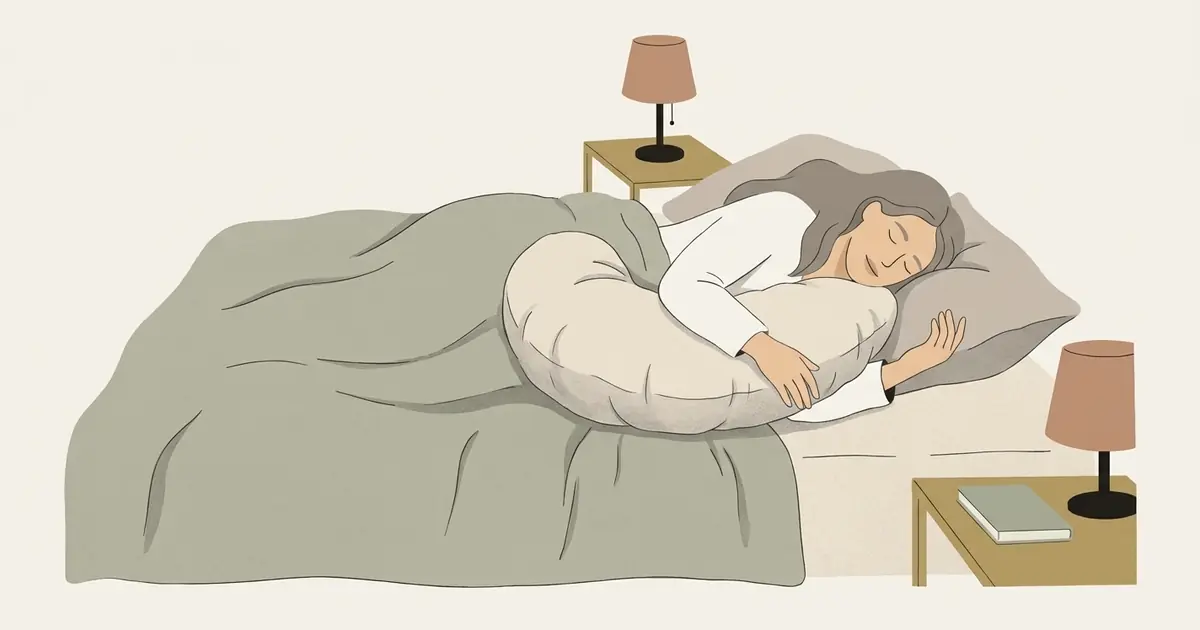 The complete guide to sleeping on your side
How to sleep on your side: line up your head, shoulders and hips, choose the right pillow height, and support your knees and back. Five fixes in 3 minutes.
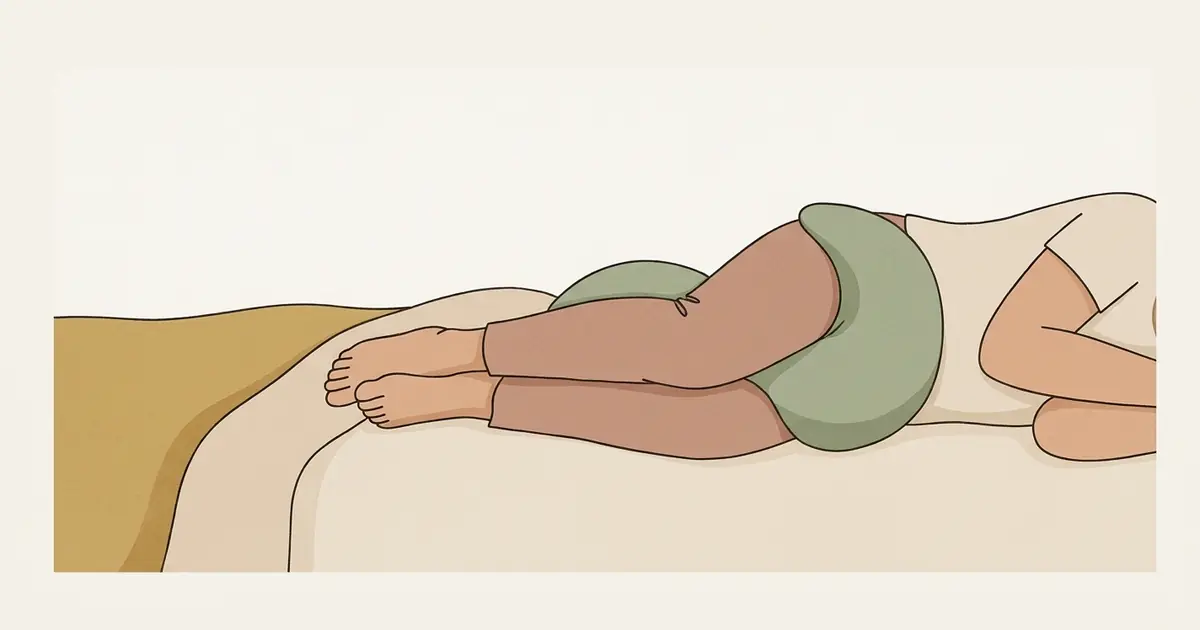 Should you sleep with a pillow between your knees
Sleeping with a pillow between your knees can relieve hip pressure and keep your legs level. Who it helps, how thick it should be, and 3 options.


