
Draft: this guide is waiting for review by a qualified reviewer and is not published yet.
Working night shifts while pregnant: planning for daytime rest
Night shift work in pregnancy needs careful planning.
By Cove editorial team · Updated October 27, 2026 · 6 min read · Editorial standards

Key takeaways
- Mapping your full journey home helps you protect the sleep window that follows it.
- Your doctor or midwife can review how shift timing, fatigue, and specific pregnancy symptoms interact for your situation.
- After 28 weeks, sleeping on your side is recommended rather than your back.
- Daytime noise and light are the main environmental factors your household can help control.
- Review your rest plan whenever your shift pattern, symptoms, or pregnancy stage changes.
Pregnancy fatigue is common, especially in the first trimester and again later in pregnancy 1. When you work nights, your sleep window falls during the day, when the house is busy, light pours in, and interruptions come easily. Protecting that window takes deliberate planning: your commute home, your room, and the people around you all matter.
Map the work pattern and travel home
Begin by writing down the full shape of your shift: when it starts, when it ends, and how long the journey home takes. The commute is not separate from your rest plan—it is the first part of it. Tiredness and dizziness are real concerns during pregnancy 2, and a long or demanding journey home shortens the window before you can sleep and adds physical strain before it begins.
If you drive, think about which parts of the journey feel most fatiguing and whether there is anyone who could take over on longer stretches. If you use public transport, a small pillow or lumbar support for the journey home can reduce discomfort, particularly if pelvic pain is already a factor 5.
Once you are home, the time between arriving and falling asleep deserves the same thought as the bedroom itself. Moving away from screens, eating lightly if needed, and keeping the environment calm can support the shift from work alertness to sleep 4. Note how long this wind-down realistically takes for you, and protect it as part of the rest block.
Map the full unit: shift end → commute → wind-down → sleep → wake. That is what you are planning around, not just the hours in bed.
Discuss symptoms and working arrangements with your care team
Bringing your care team a clear picture of your shift pattern lets them give you relevant, specific advice. Several common pregnancy symptoms are directly affected by when and how you sleep, and your doctor or midwife needs the detail to be useful.
After 28 weeks, the recommendation is to sleep on your side rather than your back 1. Research suggests that falling asleep on your back after 28 weeks can double the risk of stillbirth, possibly related to blood and oxygen flow to the baby 1. This applies to daytime sleep just as it does to overnight sleep. If you are already past that stage, or will reach it while working nights, ask your care team how to make side-sleeping more comfortable given your hours.
Heartburn is more common from 12 weeks onwards and is worsened by eating close to lying down 3. If your shift includes a meal break shortly before you plan to sleep, that is worth raising. Frequent urination is another common disruptor at any hour 2, and the same practical questions apply regardless of when your sleep window falls.
If you are experiencing leg cramps, pelvic pain 5, shortness of breath, or significant fatigue, describe when these are worst and whether they cluster around shift timing, posture at work, or the commute home. That kind of pattern is useful clinical information.
For workplace arrangements—adjusted hours, rest breaks, or a formal risk assessment—your employer's occupational health or HR team is the right starting point, since policies vary by sector and jurisdiction. The guide on rest breaks at work during pregnancy covers the practical steps of making that conversation productive.
Prepare a daytime rest environment
Daytime sleep asks your body to rest in conditions it is not naturally cued for: ambient light, household noise, and the general activity of a waking world. Each of those can be addressed.
**Light** is the most straightforward factor. Blackout curtains are the most effective single change. If the room cannot be fully darkened, a well-fitted sleep mask can compensate. A sleep mask that works with side sleeping is worth checking before you buy, since many standard masks shift when you turn over.
**Temperature** tends to run higher during pregnancy because of hormonal changes and increased blood supply to the skin 2. Keeping the room cool through ventilation, a fan, or lighter bedding layers can help. Wearing loose clothing made from breathable natural fibers is also recommended for comfort during pregnancy 2.
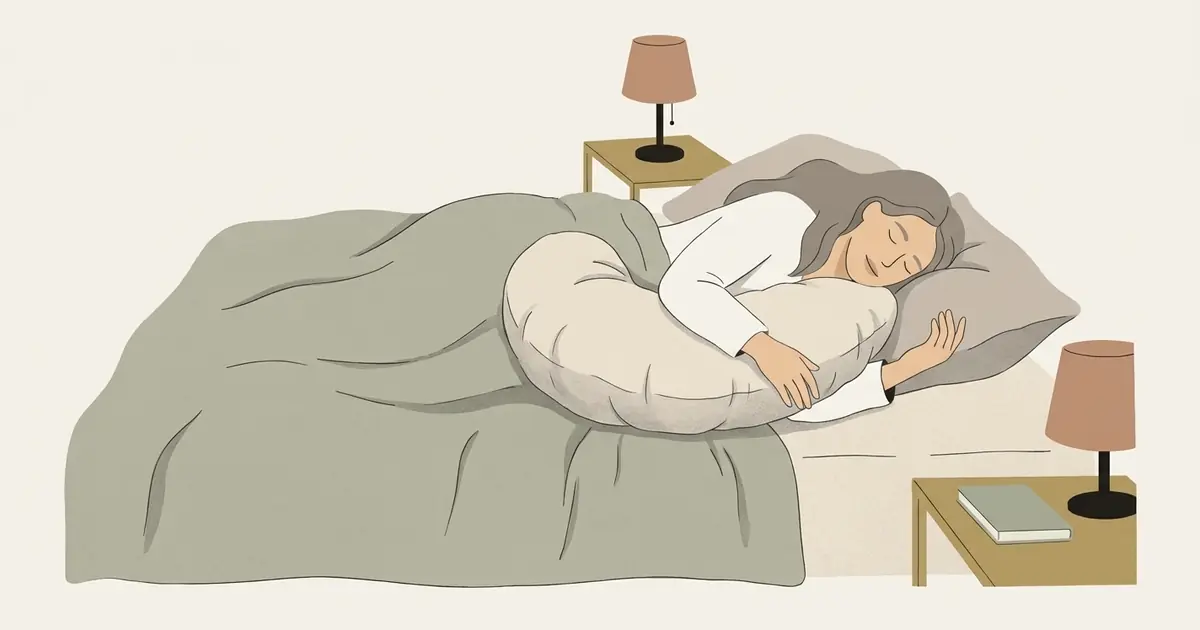
**Position** matters for both rest quality and safety. From 28 weeks, side-sleeping is the recommended approach 1. Supporting your bump with a pillow and placing a pillow between your knees can make side-sleeping more comfortable 1. A full-length crescent pillow such as The Cove Pregnancy Pillow—about 52 in [132 cm] along the curve with adjustable shredded gel memory foam fill and a machine-washable Tencel lyocell blend cover—is designed for exactly this setup. If you also want something for a rest break on the couch before your commute, The Cove Pregnancy Pillow Mini is the smaller version that works as a knee or back pillow and packs into a suitcase.
For more on positioning mechanics, the complete guide to sleeping on your side covers what changes across trimesters and how to adjust your setup.
**Sound** is harder to control than light. Earplugs, a white noise machine, or a fan can mask variable household noise more reliably than asking everyone to be silent 4. Use whichever combination lets you stay asleep through normal household activity rather than depending entirely on others staying quiet.
Agree on household quiet and interruptions
The most carefully prepared sleep environment can be undone by a knock on the door or a loud conversation in the hallway. A household agreement about your sleep window is a practical necessity, not an unusual request.
The checklist below covers the main points to work through with anyone who shares your home:
- [ ] Write your planned sleep hours somewhere visible to everyone in the household
- [ ] Agree on a genuine emergency threshold—the only reason to wake you during your window
- [ ] Redirect phone calls or set your phone to a do-not-disturb schedule for your sleep hours
- [ ] Anticipate regular deliveries and arrange for them to be received without knocking or ringing
- [ ] Identify which appliances are loudest (vacuum, washing machine, blender) and agree on times to use them outside your window
- [ ] Place a quiet-hours note on the bedroom door as a low-friction, visible reminder
- [ ] Discuss what happens if a child in the home needs something during your window—agree on who covers this
- [ ] Confirm your wake-up arrangement so you are not anxious about oversleeping before your next shift
- [ ] Review the agreement whenever your shift pattern changes, not only when friction arises
If you are navigating rest around a young child already in the household, the guide on finding time to rest during pregnancy when you have a toddler addresses that overlap directly and offers practical strategies for splitting the coverage.
Review the plan when shifts or needs change
A rest plan that works at 20 weeks may not work at 32 weeks. Physical changes—a larger bump, increased pelvic discomfort 5, more frequent urination, or more pronounced fatigue 1—can shift what you need from your sleep environment and from the people around you. Sleep disorders including restless legs syndrome and sleep apnea are also more common during pregnancy and can develop or worsen as pregnancy progresses 6.
Shift patterns can change too: different hours, extra or reduced nights, a rotation, or a temporary redeployment. Each change can affect your commute timing, your wind-down window, and the hours when your household needs to be quiet.
Building a brief review into your routine—perhaps when you attend a prenatal appointment—keeps the plan current rather than reactive. A pregnancy sleep diary to take to your next appointment can help you track patterns over time and give your care team concrete information rather than general impressions. If symptoms are significantly disrupting your sleep, mention that directly; your care team can help determine whether further assessment is warranted 6.
Sleep quality during pregnancy matters for both you and your baby 6. Night-shift work adds genuine complexity, but mapping the full rest window, talking to your care team with specifics, preparing the room, and reaching clear agreements with your household give you a structure that can be adapted as things change.
More in this series: start with Sleeping during pregnancy and working at a desk while pregnant: a comfort check for your setup.
From Cove


Questions
Bring a clear picture of your shift pattern: start and finish times, commute length, how many nights per week, and how long you have been on this schedule. Ask how fatigue and disrupted sleep might interact with symptoms you are already experiencing, such as nausea, heartburn, frequent urination, or pelvic pain. If you are past 28 weeks, ask about side-sleeping positions and whether your current setup supports that. Also ask whether any symptoms—dizziness, leg cramps, shortness of breath—need specific attention given that you are awake and active overnight. Your care team can advise on your individual situation; they cannot do that without the detail.
The most useful things your household can do are control noise and light during your sleep window, and agree on how and when they may wake you. Write down your planned sleep hours so everyone knows when the quiet period starts and ends. Ask that phone calls be redirected, deliveries anticipated, and loud appliances (vacuum, washing machine) used outside your window. Blackout curtains or a sleep mask help with daylight. A sign on the bedroom door can serve as a visible reminder without requiring repeated conversation. Agree in advance on a genuine emergency threshold so you are not woken for minor things.
Start with your employer's occupational health team or HR department, who should hold copies of any night-work and pregnancy risk-assessment policies. Your employment contract and any collective agreements may also be relevant. Because policies and legal protections vary by country, state, and sector, this guide does not state what your employer is required to do. If you need independent advice, a trade union representative or an employment advisory service in your jurisdiction is the appropriate starting point.
After 28 weeks, going to sleep on your back is not recommended because it has been linked to a higher risk of stillbirth, possibly related to blood and oxygen flow to the baby [^1]. The advice applies regardless of what time of day you sleep. If you wake up on your back, turn onto your side and settle again. Supporting your bump with pillows and placing a pillow between your knees can help you stay comfortable on your side [^1].
Both are common in pregnancy and can disrupt any sleep window, day or night [^2][^3]. For heartburn, avoid eating a large meal in the final hours before you plan to sleep, and try propping your head and shoulders slightly; sleeping on your left side may also help [^3]. For frequent urination, NHS guidance suggests cutting back on drinks in the hours before your sleep window while keeping well hydrated during your waking hours [^2]. If either symptom is severe or getting worse, mention it at your next care appointment.
Sources
- Tiredness and sleep problems in pregnancy, NHS. Accessed October 27, 2026.
- Common health problems in pregnancy, NHS. Accessed October 27, 2026.
- Indigestion and heartburn in pregnancy, NHS. Accessed October 27, 2026.
- How to fall asleep faster and sleep better, NHS Every Mind Matters. Accessed October 27, 2026.
- Pelvic pain in pregnancy, NHS. Accessed October 27, 2026.
- Pregnancy and sleep, Sleep Foundation. Accessed October 27, 2026.
About the author
The Cove editorial team is the group at Cove that writes our guides. We write them from published guidance and our own product testing, and link every source. About the team
Related guides
 Rest breaks at work during pregnancy: make a practical plan
Planning rest breaks at work from 18 weeks helps you stay consistent and comfortable through each trimester without starting over each time.
 The complete guide to sleeping on your side
How to sleep on your side: line up your head, shoulders and hips, choose the right pillow height, and support your knees and back. Five fixes in 3 minutes.
 A pregnancy sleep diary to take to your next appointment
Follow 3 steps to log sleep timing, awakenings, and symptoms over a few nights so your doctor or midwife has something concrete to work with.


