
Working at a desk while pregnant: a comfort check for your setup
A practical checklist for adjusting your desk, chair, and position to fit your changing body during pregnancy.
By Cove editorial team · Updated October 27, 2026 · 6 min read · Editorial standards

Key takeaways
- Your center of gravity and seated posture shift as your bump grows, so a setup that worked earlier in pregnancy may need revisiting each trimester.
- Feet fully supported, back in contact with the chair, and arms roughly parallel to the desk are the basic targets for a neutral seated position.
- Adding a small pillow behind your lower back is optional support, not a substitute for a chair that fits you properly.
- Changing position frequently throughout the day matters as much as any single adjustment to your workstation.
- A doctor, midwife, or occupational health adviser can review your specific situation if discomfort persists.
Pregnancy changes your posture, raises your core temperature, and shifts where your weight sits, all of which affect how you interact with a desk chair. A setup that worked early on may create new pressure points weeks later. Reviewing five workstation areas each trimester takes under ten minutes and can reduce discomfort that builds across a working day. 5
Notice what has become awkward
Before touching any equipment, spend one working day paying attention to what specifically bothers you. Note where you feel pressure, tension, or fatigue: the lower back, the upper back and shoulders, the wrists, the thighs, or behind the knees. Notice whether symptoms arrive early in the day or only after several hours. This information is more useful than a generic checklist because it tells you which parts of your setup to prioritize—and it gives you something concrete to describe if you later speak to a midwife or occupational health adviser.
Common patterns during pregnancy include a lower back that loses contact with the chair backrest as the bump grows, thighs that start pressing harder against the seat edge, and wrists that drift out of alignment because you are reaching slightly farther to the keyboard. None of these are unusual, and most are addressable with small adjustments.
Keeping a brief record of when and where discomfort occurs—time of day, task you were doing, how long you had been sitting—also makes any appointment more productive. A pregnancy sleep diary to take to your next appointment follows a similar principle and can help you track patterns across both your working day and your nights.
Check reach, chair space, and foot support
The target for a neutral seated position at a desk is: hands and forearms roughly parallel to the floor, shoulders relaxed, elbows close to the body and bent between 90 and 120 degrees, back fully supported, thighs roughly parallel to the floor, and feet fully supported by the floor or a footrest 1. During pregnancy, the bump gradually pushes your center of gravity forward, which can tip the pelvis and flatten the lower back's natural curve.
Work through this sequence before you start your next working day:
- [ ] Sit back fully in the chair so your back makes contact with the backrest.
- [ ] Check that your feet rest flat on the floor or on a footrest—thighs roughly level, knees at about the same height as your hips 1.
- [ ] Confirm there is a hand-width of clearance between the front edge of the seat and the back of your knee; if not, the seat is too deep or the chair height needs raising.
- [ ] Set the monitor so the top of the screen is at or just below eye level and about an arm's length away.
- [ ] Place the keyboard so your elbows stay close to your sides—not reaching forward.
- [ ] Check that the chair's lumbar support (or a pillow) makes contact with your lower back, not your mid-back.
- [ ] If your desk is too high for your chair height to bring your arms parallel to the floor, a monitor riser and keyboard tray can help; ask your employer's facilities or health and safety team.
Repeat this check whenever something starts to feel off. What fits at twenty weeks may need a small tweak at thirty.
Test optional support without crowding the seat
A pillow placed between your lower back and the chair backrest is supplementary—it fills the gap that often opens up as the bump changes your seated posture. It is not a replacement for a chair that fits you. If the chair's built-in lumbar support is already making good contact, you may not need anything extra.
If there is a gap, a small, compressible pillow can help. The Cove Pregnancy Pillow Mini is a compact crescent designed specifically as a back or knee pillow and packs into a suitcase, which makes it practical for both the office and travel. If you want support behind the bump at home rather than just at the lower back, The Cove Pregnancy Pillow is the full-length version, about 52 in [132 cm] along the curve, suited to side sleeping and seated support on a sofa or wide chair.
When testing any pillow at your desk, check three things: your back still makes full contact with the chair, you have not been pushed so far forward that you are perching on the seat edge, and your arms can still reach the keyboard without your shoulders rising. If any of these are affected, the pillow is too thick for that position or placed too low.
Feeling hotter than usual is common in pregnancy due to hormonal changes and increased blood flow to the skin 2. If the office is hot, keep a layer you can remove easily, use a small fan at your desk if your workplace allows it, and keep water within easy reach.
Plan changes of position within your care advice
Working in the same posture for prolonged periods is not healthy regardless of how good your setup is 1. Pregnancy adds further reason to move regularly: circulation slows when you sit still for long stretches, and leg cramp—common in pregnancy—may be eased by regular gentle foot and ankle movement 2.
Practical ways to build movement into a desk day:
| Approach | What it involves | Frequency |
|---|---|---|
| Seated foot exercises | Flex and rotate ankles, wiggle toes 2 | Every 30–45 min |
| Stand and walk | Walk to a colleague, get water, use a different floor's bathroom | Every 60–90 min |
| Chair adjustments | Small shifts to backrest angle or seat height 1 | As needed |
| Standing tasks | Reading documents, phone calls, brief meetings | Where your workplace allows |
If you experience heartburn or acid reflux—common in pregnancy as the growing baby presses against the stomach 4—sitting upright rather than slumping after eating at your desk can help reduce symptoms. Eating smaller amounts more frequently during the working day, rather than a large lunch, may also help 4.
Rising slowly from your chair matters too. Standing up quickly from a seated position can trigger faintness because of the circulatory changes pregnancy causes 2. Getting up gradually and pausing briefly before walking gives your blood pressure time to adjust.
For more on how daytime posture habits connect to nighttime discomfort, side sleeping and lower back pain covers the overlap in detail.
Ask for help when discomfort persists
A self-check covers the basics, but it has limits. If you have persistent lower back pain, numbness or tingling in your hands or legs, pelvic pain, or any symptom that is worsening, speak to your midwife or doctor before making further adjustments on your own. Musculoskeletal symptoms in pregnancy can have causes that workstation changes will not address.
Sleep quality often reflects what has accumulated during the day. Poor sleep during pregnancy is common and can be linked to a range of physical discomforts 3. If back or hip pain that starts at your desk is also affecting your nights, that pattern is worth raising at your next appointment.
Your employer has a duty to carry out a risk assessment for pregnant employees in most workplaces; your human resources or health and safety contact can confirm what applies in your situation and arrange for an occupational health review if needed. An occupational health adviser can assess your actual workstation rather than working from a general checklist, and can make specific recommendations about equipment such as a height-adjustable desk, a different chair, or a footrest.
If pelvic discomfort is part of the picture, a pelvic-health appointment for pregnancy sleep: how to prepare explains what to expect and how to make the most of a specialist referral. Going in with clear notes about when symptoms occur and what makes them better or worse will help any clinician give you more specific guidance.
More in this series: start with Sleeping during pregnancy, finding time to rest during pregnancy when you have a toddler and rest breaks at work during pregnancy: make a practical plan.
From Cove


Questions
If adding any pillow behind your back slides you toward the edge of the seat, it is too thick or placed too low. Try a thinner or more compressible option, or position it higher up at the mid-back rather than the lumbar curve. If you still feel pushed forward, the chair depth or lumbar support built into the chair may need adjusting instead. A pillow should fill a gap between your back and the chair, not create a new one between you and the desk.
Yes, a small pillow placed between your lower back and the chair backrest can help maintain contact with the seat when your growing bump pulls your center of gravity forward. The Cove Pregnancy Pillow Mini is a compact crescent designed as a back or knee pillow and packs into a suitcase, which makes it a practical option for the office or a commute. The goal is to support the natural curve of your back without forcing you away from the desk.
Your employer may have an occupational health adviser or an ergonomics assessor who can review your workstation in person. Your midwife or doctor can address any musculoskeletal symptoms and refer you onward if needed. If your workplace has a human resources or health and safety team, they are a practical first contact for equipment requests such as a footrest, adjustable chair, or monitor riser.
Staying in any one posture for a prolonged period is not healthy regardless of how well-adjusted your setup is [^1]. Building short movement breaks into your day—standing up, walking to a colleague, or doing a few gentle foot and ankle circles—helps keep circulation moving. Ankle and leg movements are particularly useful during pregnancy because regular gentle exercise may help with circulation and reduce leg cramp [^2]. A rough target of changing position every 30 to 45 minutes is a reasonable starting point to discuss with your midwife.
Feeling faint on standing is common in pregnancy, often because of hormonal changes affecting blood flow [^2]. Rising slowly from your chair rather than standing up quickly can help reduce this. If faintness is frequent or accompanied by other symptoms, mention it to your midwife or doctor rather than trying to manage it through workstation adjustments alone.
Sources
- Computer workstations: neutral working postures, Occupational Safety and Health Administration. Accessed October 27, 2026.
- Common health problems in pregnancy, NHS. Accessed October 27, 2026.
- Tiredness and sleep problems in pregnancy, NHS. Accessed October 27, 2026.
- Indigestion and heartburn in pregnancy, NHS. Accessed October 27, 2026.
- Pregnancy and sleep, Sleep Foundation. Accessed October 27, 2026.
About the author
The Cove editorial team is the group at Cove that writes our guides. We write them from published guidance and our own product testing, and link every source. About the team
Related guides
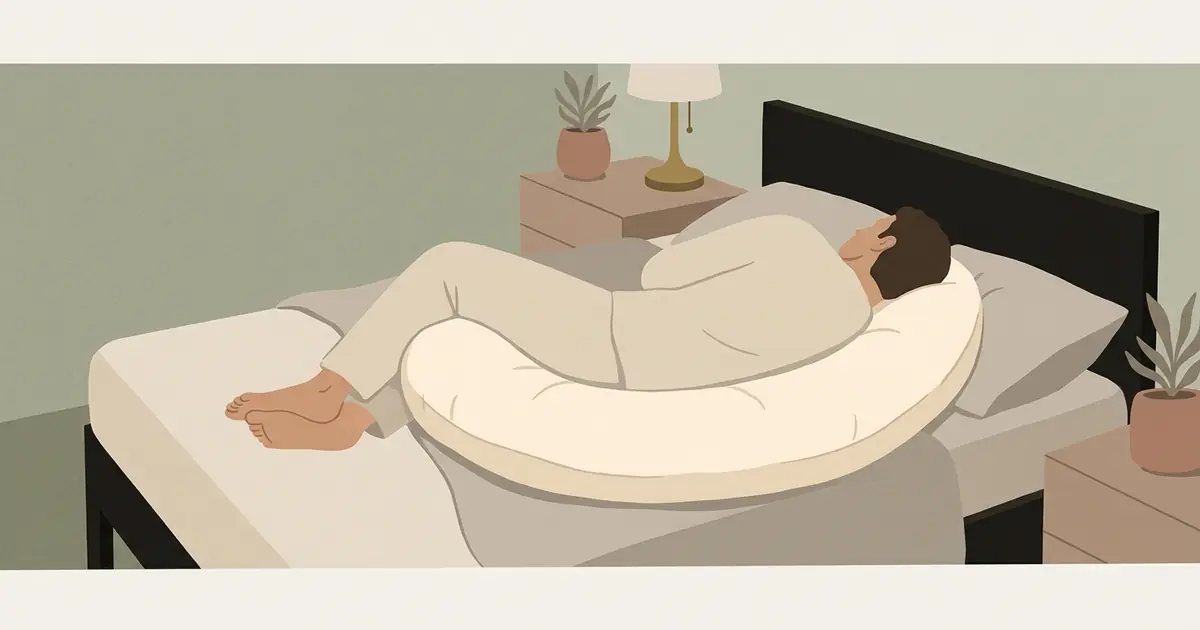 Side sleeping and lower back pain
: how knee and back support keep the spine level, 3 pillow setups to try over 7 nights, and when the NHS says to get help.
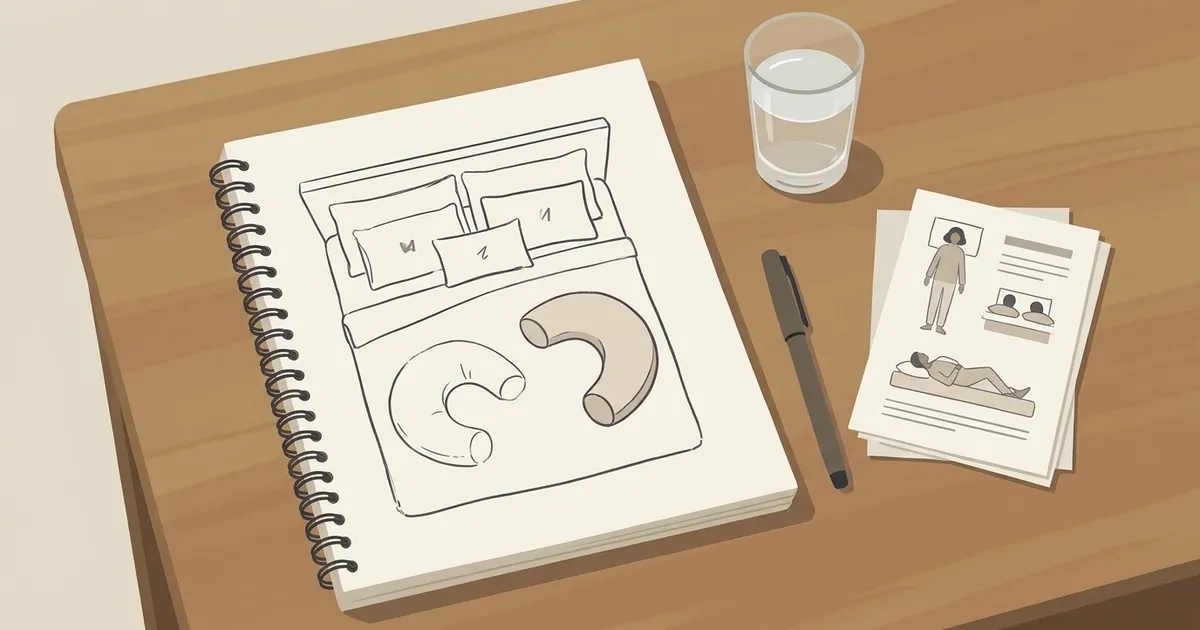 A pelvic-health appointment for pregnancy sleep: how to prepare
Getting ready for a pelvic health physiotherapy visit? This checklist covers what to bring and ask, including sleep advice given after 28 weeks.
 A pregnancy sleep diary to take to your next appointment
Follow 3 steps to log sleep timing, awakenings, and symptoms over a few nights so your doctor or midwife has something concrete to work with.


