
Draft: this guide is waiting for review by a qualified reviewer and is not published yet.
Caffeine during pregnancy: reading labels before your evening drink
Use these 5 steps to read caffeine labels on coffee, tea, chocolate and energy drinks and keep your daily total where your clinician wants it.
By Cove editorial team · Updated October 27, 2026 · 6 min read · Editorial standards

Key takeaways
- Current guidance from ACOG sets a limit of less than 200 mg of caffeine per day during pregnancy, but you should confirm your personal limit with your own doctor or midwife.
- A stated caffeine amount on a label only tells part of the story—serving size determines how much caffeine one portion actually delivers.
- Coffee, tea, chocolate, soft drinks, and energy products can all contribute caffeine, so totaling across the day matters.
- When a label does not state a caffeine amount, treat that as a reason to check with your clinician before consuming the product.
- No specific cutoff time for caffeine consumption guarantees better sleep; your clinician is the right person to advise on timing for your situation.
Tracking your caffeine intake during pregnancy means reading labels carefully, not just scanning the front of a package. ACOG recommends staying below 200 mg per day 1, but putting that into practice requires checking serving sizes, adding up amounts across everything you consume, and knowing how to handle products that list no caffeine figure at all.
Find current pregnancy guidance before doing the math
Before you start calculating, it helps to have a clear reference point. ACOG advises pregnant people to consume less than 200 mg of caffeine per day 1. That is a population-level upper limit, not a personal prescription—your doctor or midwife may suggest a different target based on your individual health history, how your body processes caffeine, and any other factors relevant to your pregnancy.
If you have not already had this conversation, raising it at your next prenatal visit is the right starting point. A pregnancy sleep diary to take to your next appointment can help you track patterns—including what and when you are drinking—so the conversation is specific rather than general. Arriving with actual product names, portion sizes, and estimated totals gives your clinician something concrete to work from.
Once you have a personal target, you can apply it to what is actually printed on the label.
Check the serving size as well as the stated amount
The most common label-reading mistake is looking at the caffeine figure without first checking the serving size. A drink label might show 95 mg of caffeine, which could look well within a 200 mg daily limit—until you notice the bottle is listed as containing two servings, making the full container closer to 190 mg on its own.
Here is a simple workflow for any packaged product:
1. Find the serving size (in fluid ounces, milliliters, grams, or pieces depending on the product type). 2. Decide how much of the product you will actually consume in one sitting. 3. Divide your intended portion by the stated serving size to get your serving multiplier. 4. Multiply the stated caffeine amount by that multiplier. 5. Add the result to your running daily total.
This step matters most for large-format drinks—oversized coffee cups, tall canned energy drinks, and multi-serving bottles—where the gap between the labeled serving and the real-world portion is widest. A 16 oz [473 ml] coffee labeled with a caffeine figure for 8 oz [237 ml] contains twice what the number suggests at a glance.
For brewed coffee and tea made at home, no label will give you a precise figure because caffeine varies by roast, bean variety, tea type, steep time, and water temperature. In those cases, a general estimate from a reliable source is more realistic than a precise number. Ask your clinician how to handle estimates in your daily tracking so you have an agreed-upon approach rather than guessing.
Remember that multiple products can contribute
Caffeine adds up across the day from more sources than most people track at once. The table below lists common product categories and notes what to look for on labels.
| Product type | Where caffeine appears on labels | Notes |
|---|---|---|
| Coffee (packaged or canned) | Nutrition facts or a caffeine callout | May list per 8 oz [237 ml] serving; home-brewed amounts vary |
| Tea (bagged or loose) | Ingredients or a caffeine callout; often absent | Herbal teas are not always caffeine-free; check for yerba mate or matcha |
| Dark chocolate and cocoa products | Ingredients list; caffeine rarely stated as a number | Darker chocolate generally contains more per gram; serving sizes are typically small |
| Soft drinks (cola, some citrus) | Nutrition facts or caffeine callout | Diet versions contain similar caffeine to their regular counterparts |
| Energy drinks and shots | Often stated prominently; check per-serving vs. per-container | Some products contain guarana in addition to listed caffeine |
| Supplements and prenatal wellness products | Ingredients list | Caffeine, guarana, green tea extract, and matcha all contribute; amounts rarely stated |
Pregnancy already disrupts sleep through physical discomfort, frequent urination, changing hormones, back pain, and anxiety 2. Keeping an accurate tally of caffeine sources across the full day is one part of managing how you feel in the evenings—but it is only one part, and it sits alongside other factors your clinician can help you address.
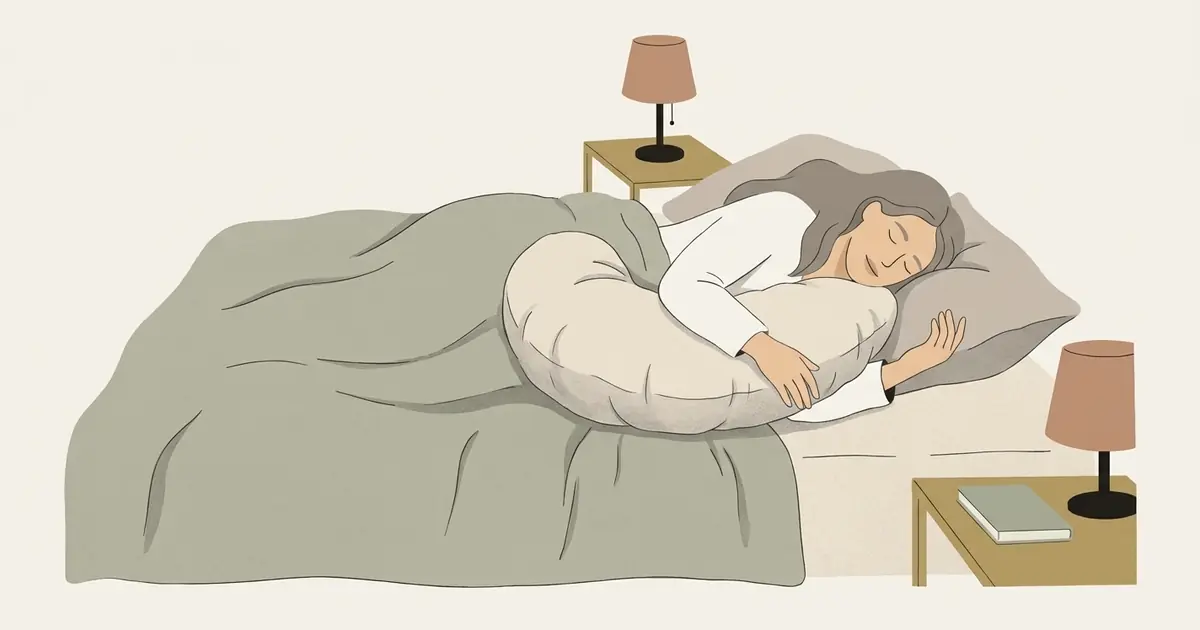
Side sleeping, which ACOG recommends during the second and third trimesters with one or both knees bent 1, also plays a role in nighttime comfort 5. If you are working on your sleep setup alongside adjusting your intake, the Cove Pregnancy Pillow is designed to support side sleeping, with an adjustable shredded gel memory foam fill you can customize through an inner zip. The complete guide to sleeping on your side covers position mechanics in more detail.
Treat unclear labels as a reason to check
Not every product that contains caffeine announces it clearly. Some labels list contributing ingredients—guarana, kola nut, yerba mate, green tea extract, matcha—without translating those into a milligram figure. Others, particularly certain supplements and functional waters, may omit any caffeine reference from the front of the packaging entirely.
If you scan an ingredients list and find any of the following, the product contains caffeine in an amount you cannot verify from the label alone:
- [ ] Caffeine (any form, including anhydrous)
- [ ] Guarana or guarana extract
- [ ] Yerba mate
- [ ] Matcha or matcha powder
- [ ] Green tea extract
- [ ] Kola nut
- [ ] Coffee fruit or coffee cherry extract
When you cannot confirm the amount, do not estimate and proceed. Set the product aside and ask your doctor or midwife whether it fits your intake plan before consuming it regularly. This applies especially to supplements and prenatal-branded wellness products, which do not always carry the same labeling detail as mainstream food and drink.
A cooler sleep environment supports the natural drop in core body temperature that precedes sleep 4, and consistent pre-sleep routines are associated with better sleep quality 3. Neither of those approaches replaces the specific clinical conversation about what your caffeine limit should be, but they are worth considering alongside your intake choices.
Ask about your own situation instead of chasing a sleep guarantee
Label literacy gives you accurate input data—it does not resolve what limit is right for you personally, or whether adjusting caffeine timing will meaningfully improve your sleep. Pregnancy sleep is disrupted by many overlapping factors 2, and no single dietary change comes with a guarantee.
The more productive approach is to bring specific, written information to your clinician: what products you are consuming, how much of each, and at what times of day. A general description is less useful than actual numbers. Note the product names, your typical portion sizes, and the approximate caffeine totals you have calculated from the label. If you are also tracking nighttime symptoms or disrupted sleep, bring that information too.
Guides like vivid dreams during pregnancy and the pregnancy sleep diary can help you frame what you are experiencing in a way that supports a focused clinical conversation. Your doctor or midwife can then advise on whether your current intake fits your situation, whether timing adjustments are worth trying for your specific pattern, and whether other factors—sleep position, a pelvic health referral, or a sleep study—are worth exploring alongside dietary changes. That conversation, grounded in real numbers from real labels, is more productive than any general rule of thumb.
More in this series: start with Sleeping during pregnancy, prescribed activity restrictions in pregnancy: questions about resting at home and working night shifts while pregnant: planning for daytime rest.
From Cove

Questions
No. 'Decaf' means the caffeine content has been significantly reduced, not eliminated. Decaffeinated coffee and tea still contain small amounts of caffeine. The exact amount varies by brand and brewing method. If you are keeping a close daily tally, count decaf servings and ask your doctor or midwife how to factor them in.
A label may list a caffeine amount that looks modest, but that figure applies only to the stated serving size—which can be a fraction of the container you actually drink. A bottle labeled as containing two or two-and-a-half servings means you need to multiply the caffeine figure accordingly. Always check the serving size line first, then the caffeine amount, before doing the math.
Treat missing information as a reason to pause. Some products—certain teas, energy waters, and supplements—contain caffeine without stating an amount on the front of the pack. Check the ingredients list for caffeine, guarana, yerba mate, matcha, or kola nut, all of which contribute caffeine. If you cannot confirm the amount, ask your doctor or midwife whether the product is suitable for your intake plan.
ACOG advises less than 200 mg per day as a general upper limit during pregnancy, but that figure is a population-level guideline, not a personal prescription. Your own situation—your health history, how your body processes caffeine, other medications or supplements—may mean a different target is appropriate for you. Use published guidance as a starting framework, then confirm your personal limit with your doctor or midwife.
It does not. Sleep during pregnancy is affected by many factors—physical discomfort, frequent urination, changing hormones, back pain, and anxiety—that have nothing to do with caffeine timing. Reducing late-day caffeine is a reasonable step, but it is not a guaranteed fix. If sleep disruption is significant, talk to your clinician rather than relying on a single dietary change.
Sources
- Can I sleep on my back when I'm pregnant?, ACOG. Accessed October 27, 2026.
- Pregnancy and sleep, Sleep Foundation. Accessed October 27, 2026.
- Sleep hygiene, Sleep Foundation. Accessed October 27, 2026.
- The best temperature for sleep, Sleep Foundation. Accessed October 27, 2026.
- Side sleeping, Sleep Foundation. Accessed October 27, 2026.
About the author
The Cove editorial team is the group at Cove that writes our guides. We write them from published guidance and our own product testing, and link every source. About the team
Related guides
 A pregnancy sleep diary to take to your next appointment
Follow 3 steps to log sleep timing, awakenings, and symptoms over a few nights so your doctor or midwife has something concrete to work with.
 Vivid dreams during pregnancy: making sense of a disrupted night
Vivid dreams are common from 28 weeks onward. Learn why they happen, what they mean, and how to settle back to sleep after waking from an upsetting one.
 The complete guide to sleeping on your side
How to sleep on your side: line up your head, shoulders and hips, choose the right pillow height, and support your knees and back. Five fixes in 3 minutes.


