
Draft: this guide is waiting for review by a qualified reviewer and is not published yet.
Preparing a shared bedroom for adult rest and a separate baby sleep space
Our 7 steps walk you through measuring clearance, storing body pillows, and confirming safe nighttime access around your newborn's bassinet.
By Cove editorial team · Updated October 27, 2026 · 6 min read · Editorial standards

Key takeaways
- Measure and mark clear floor paths around both the adult bed and the infant sleep surface before moving any furniture.
- Adult pillows, including full-length body pillows, belong on the adult bed or stored away from the baby's sleep area — never inside or alongside the infant sleep surface.
- Infants should sleep on their backs on a firm, flat, clear surface in a safety-approved crib or bassinet, free of pillows, blankets, and soft objects.
- Route cords for white noise machines, fans, and other equipment along baseboards and away from the bassinet before your baby comes home.
- Walk through your full nighttime routine — feeding, settling, returning to bed — in low light before the baby arrives so you can catch layout problems early.
Sharing a bedroom with a newborn takes planning before the baby comes home. The three tasks that matter most are keeping the infant sleep surface separate from adult bedding, giving every large sleep item a defined storage spot, and confirming you can move safely through the room in the dark. Starting early gives you time to adjust.
Start with the infant sleep product's instructions
Every crib and bassinet comes with manufacturer guidelines that specify how to assemble the product, what surface it must sit on, and whether any clearance from walls or furniture is required. Read those instructions fully before you position anything else in the room.
The NICHD Safe to Sleep program is direct on what the infant sleep surface must look like: a firm, flat surface in a safety-approved crib or bassinet, with the baby placed on their back, and no pillows, soft comforters, quilts, or blankets in or around the sleep area 1. Room-sharing — keeping the bassinet next to your bed — is supported because it makes overnight feeding easier and allows you to return the baby to their own sleep area when feeding is complete 1. Bed-sharing is a separate matter with separate risks; the two are not the same thing.
Once the bassinet is correctly assembled and positioned, treat its footprint plus a comfortable arm's-reach margin as a clear zone. Nothing soft or loose enters that zone at any point, day or night.
Measure clear access around the adult bed
Before you move any furniture, measure the room and sketch a rough floor plan on paper. Note the positions of outlets, door swings, and the route you will walk from your side of the bed to the bassinet.
You need a usable path on at least one side of the adult bed — wide enough to stand, turn, and reach the bassinet without stepping over anything. A general working target is 24–30 in (61–76 cm), though your room may allow more. Mark that path with painter's tape on the floor during the planning stage so you can see whether furniture placement actually preserves it.
Also think through the full nighttime sequence when you are fatigued: from your side of the bed, to the bassinet, to a feeding chair if you use one, and back to bed. Each step of that route should be free of bags, charging cables, and loose items on the floor. Check that you can reach the bassinet from your side of the bed without climbing over a partner — that detail becomes important at 2 a.m.
Give adult pillows a place away from the baby's surface
A full-length body pillow is a significant physical object in a small room. The Cove Pregnancy Pillow runs about 52 in (132 cm) along the curve — nearly the length of a twin bed — so it needs a deliberate home when not in use. NICHD guidance makes clear that pillows and soft items near an infant sleep area create suffocation and entrapment risks 1. That means your body pillow needs to stay on the adult bed or in storage, with no realistic way it could migrate toward the bassinet during the night.
In practice, the simplest approach is to place the body pillow against the wall-side of the adult bed when you are not actively using it, or fold it toward the foot of the bed. If your room is very tight, a smaller option like the Cove Pregnancy Pillow Mini can be tucked into a bag or on a shelf when not in use. Either way, establish the habit before the baby arrives so it becomes automatic under fatigue.
Using a body pillow for postpartum side sleeping can support spinal alignment and reduce pressure on hips and lower back — side sleeping is associated with reduced pain in the back and neck 4, and the postpartum recovery period is precisely when that support tends to matter. The point is not to stop using the pillow but to give it a defined place so it never ends up anywhere near the infant sleep surface. For more on managing side-sleeping comfort after birth, see side sleeping and lower back pain and how to sleep on your side without hip pain.
Route cords and place equipment according to instructions
White noise machines, fans, and other bedroom accessories all come with placement instructions. Follow those instructions for each device first, then work through this checklist:
- [ ] Confirm each device's cord reaches its outlet without crossing a walking path
- [ ] Route cords along baseboards and secure with cord clips or cable channels if needed
- [ ] Verify no cord can dangle near, over, or into the bassinet
- [ ] Place each device on a stable, flat surface — not on top of the bassinet or on soft bedding
- [ ] Check that no device is positioned where it could be knocked onto the infant sleep surface
- [ ] Confirm the bassinet's own cord (if it has one) is routed per its manufacturer's instructions
- [ ] Test every outlet you plan to use before finalizing the furniture layout
- [ ] Check that no device's exhaust, airflow, or vibration is directed at the bassinet
Room temperature is worth addressing at this stage. Most adults sleep best in a room around 65–68°F (18.3–20°C) 2, and a room that is comfortable for a resting adult is generally suitable for an infant as well — though a room that is too hot can increase SIDS risk, so err toward the cooler end and use appropriate infant sleepwear rather than extra blankets in the bassinet 2. A fan pointed at the wall rather than directly at the baby can help circulate air on hotter nights without creating a concentrated draft. Managing temperature through the thermostat, breathable layers, and airflow rather than additional soft bedding is the right approach for both occupants of the room 5.
Test ordinary nighttime movements before the baby arrives
Once the room is arranged, run through your expected nighttime sequence at least once in low or no light. Move slowly and note every obstacle. A numbered walkthrough keeps this systematic:
1. Wake from sleep on your side of the bed. 2. Locate the bassinet by feel or dim light without turning on overhead lights. 3. Move to the bassinet along your planned path, noting any objects underfoot. 4. Reach the baby and lift safely from the clear, flat surface. 5. Move to your feeding position — chair, edge of the bed, or wherever you plan to feed. 6. Return the baby to the bassinet on their back on the firm, flat surface 1. 7. Return to bed and confirm the body pillow is in its designated spot, away from the bassinet.
Note anything that causes you to hesitate or step around: a bag in the path, a cord across the floor, a piece of furniture at shin height. Adjust the layout before the baby is home. Problems that seem minor in daylight become significant when you are exhausted and operating in the dark.
If you use a body pillow for postpartum side sleeping, practice moving it from your sleeping position to its storage spot in a single motion during this walkthrough. The goal is a sequence so simple and consistent that you can perform it half-asleep without variation. Sleep quality in the postpartum period depends partly on having a sleep environment that requires no decision-making in the night 5. For more on thinking through which support products make sense at different stages, pregnancy pillow vs nursing pillow: do you need both? covers the distinction clearly.
The room planning checklist and walkthrough together take less than an hour — time that is far easier to spend now than after the baby arrives and your available sleep is measured in short intervals.
More in this series: start with Sleeping during pregnancy, planning postpartum rest in a home with stairs and including rest and comfort preferences in your birth plan.
From Cove


Questions
Store it on the adult bed, pushed to the far side or foot, or in a dedicated spot on the floor away from the bassinet. A crescent pillow like The Cove Pregnancy Pillow is about 52 in (132 cm) along the curve, so it needs a clear surface or floor space of roughly that length. Keep it well clear of the infant sleep area so it cannot shift toward the bassinet during the night. If space is tight, the smaller Cove Pregnancy Pillow Mini packs away easily and takes up less floor area when not in use.
No. Pillows, rolled blankets, and similar soft items must not be placed inside or alongside an infant sleep surface. The NICHD Safe to Sleep guidance is clear that pillows and soft comforters in the area where a baby sleeps put the baby at risk for suffocation, strangulation, or entrapment. The infant's sleep surface should be firm, flat, and completely clear. If you need to define a space for the baby, use a safety-approved crib or bassinet — those products are designed and tested for that purpose.
Start with the manufacturer's placement instructions for that specific device — follow them exactly. Then check that the cord can reach the outlet without crossing a walking path, can be routed along a baseboard, and cannot dangle anywhere near the bassinet. Make sure the device itself sits on a stable surface at a safe distance from the infant sleep area. Test whether the cord length and outlet position work before you commit to a furniture layout, since moving a heavy bed after everything is set up is difficult.
The infant product's instructions will specify any required clearances — follow those numbers. As a general rule, you want enough room on at least one side to stand, lean over, and lift the baby without twisting or stepping over objects. Keep that path free of bags, pillows, and charging cables at all times, not just during the day.
NICHD guidance supports keeping the baby's sleep area in your room, next to your bed, to allow easier feeding and comforting, especially overnight. The key point is that room-sharing is not the same as bed-sharing: the baby sleeps in their own safety-approved crib or bassinet, on their back, on a firm flat surface. When feeding is finished, the baby goes back to that separate sleep area.
Most sleep guidance suggests a bedroom temperature around 65–68°F (18.3–20°C) for adults, while infants may benefit from a slightly higher temperature setting up to around 69°F (20.5°C) — though a room that is too hot can increase SIDS risk. A room temperature comfortable for a resting adult is generally acceptable for a baby too. Use a thermostat rather than extra blankets in the bassinet to manage temperature, and dress the baby in appropriate sleepwear rather than adding soft bedding.
Sources
- Breastfeeding & Safe Sleep, NIH / NICHD Safe to Sleep. Accessed October 27, 2026.
- The best temperature for sleep, Sleep Foundation. Accessed October 27, 2026.
- Pregnancy and sleep, Sleep Foundation. Accessed October 27, 2026.
- Side sleeping, Sleep Foundation. Accessed October 27, 2026.
- Sleep hygiene, Sleep Foundation. Accessed October 27, 2026.
About the author
The Cove editorial team is the group at Cove that writes our guides. We write them from published guidance and our own product testing, and link every source. About the team
Related guides
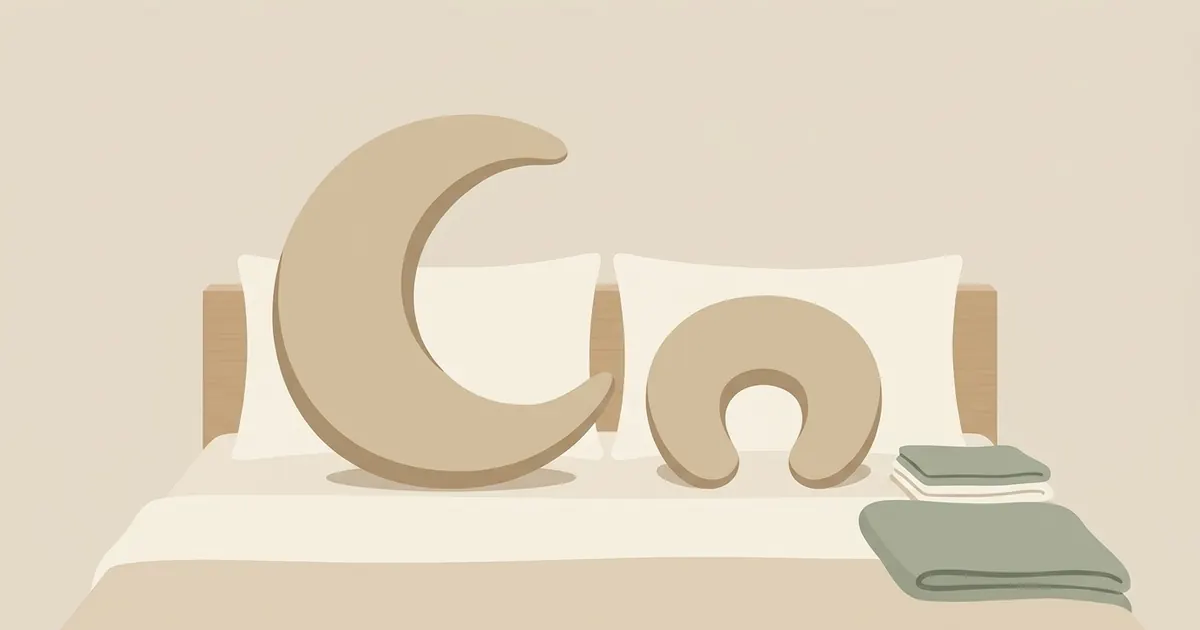 Pregnancy pillow vs nursing pillow: do you need both?
At 52 inches along the curve, a full length pregnancy pillow supports adults during sleep. Learn why it cannot replace a purpose built nursing pillow.
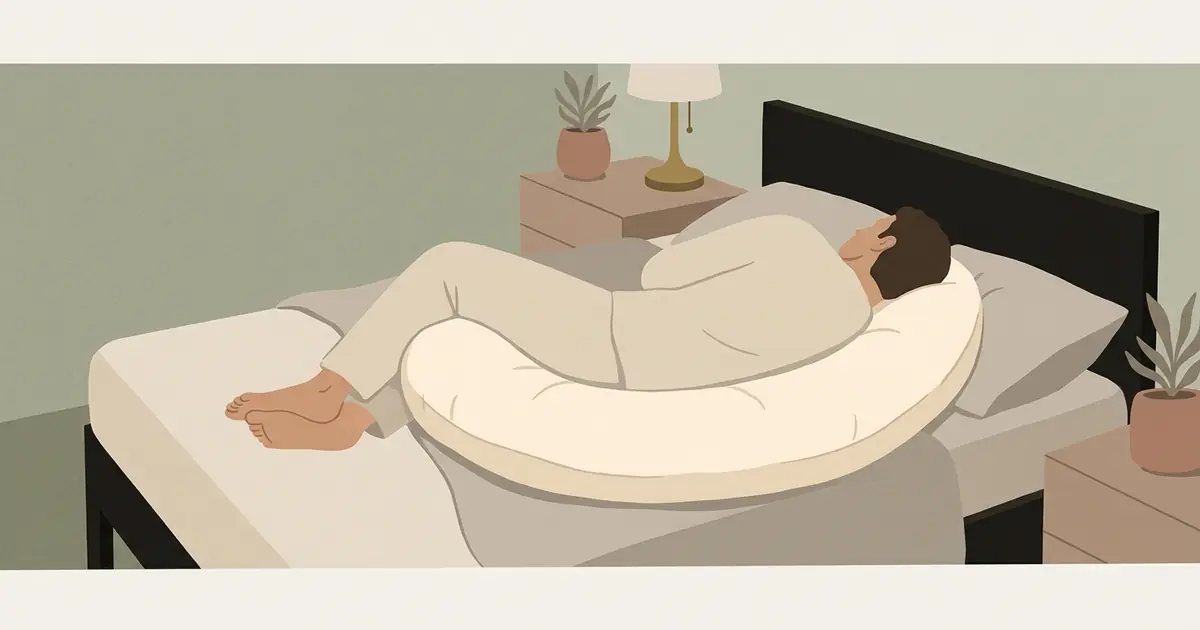 Side sleeping and lower back pain
: how knee and back support keep the spine level, 3 pillow setups to try over 7 nights, and when the NHS says to get help.
 How to sleep on your side without hip pain
Side sleeping hip pain often starts with the top knee dropping. A pillow between the knees eases hip pressure. Four setup steps and a 100 night trial.


